
 Global
GELJET Technology
Background
Inkjet printer technology has continued to make significant advances, especially for applications such as postcard and photo printing. Consequently, Inkjet printers have become widely used as convenient color printers for home use. Subsequently, they were increasingly used at offices as printers for business applications thanks to their lower unit prices and use of water-resistant pigmented inks. However, conventional inkjet systems were not able to deliver the performance of laser systems in terms of image quality (character quality and image density) on plain paper and printing speed (including duplex printing speed), and the running costs of ink and other printing supplies were not at a satisfactory level for general business use.
Solutions
To provide a top class printing environment for general business use, Ricoh developed a printer equipped with its unique inkjet technology, GELJET, and launched it in 2003. The model achieved high image quality on plain paper, high-speed printing, and low running costs. This technology is also incorporated in the GELJET printers we currently offer.
Technical highlights
1. GELJET Viscous Ink
- High image quality without bleeding, even on plain paper
- Resistant to water and fading (high water resistance & light stability)
Its high viscosity and high permeability allow the ink to set and dry instantly upon contact with the paper, thereby reducing bleeding and spreading. Furthermore, by increasing the amount of colorant that stays on the surface of the paper, it achieves sharper and more beautiful printing quality. Improved permeability also contributes to quick-drying, enabling faster printing speeds. Under normal office conditions, the viscous ink provides light stability equivalent to approximately 50 years, so documents can be safely stored in regular facilities without special environmental settings.
About the light stability of ink
Calculation method: Predicted value simulated according to Digital Color Photo Print Stability Evaluation (JEITA CP-3901)
[Prerequisites of light stability] Storage condition: Displayed under indoor light; Environmental condition: Temperature 23°C, humidity 50%; Paper: Ricoh My Recycled Paper 100
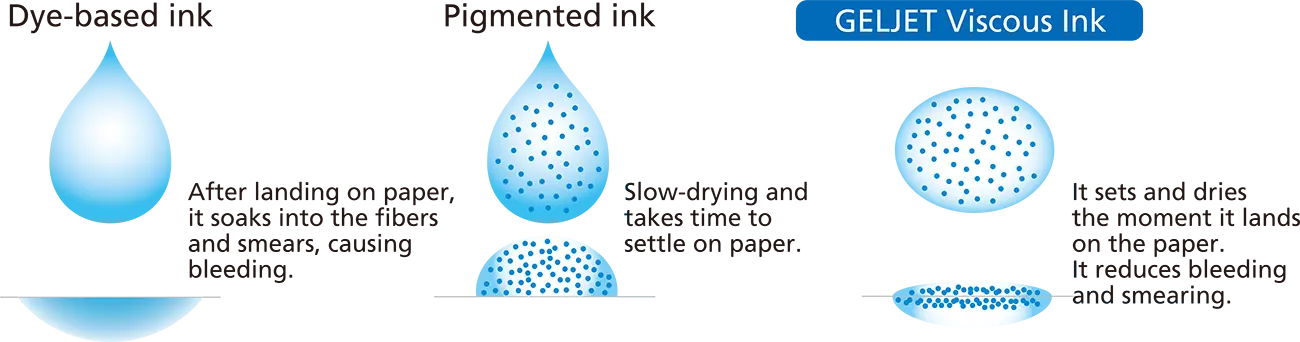
Comparison of GELJET Viscous Ink, pigmented ink, and dye-based ink
2. GELJET Wide Printhead
- High-speed printing
- High image quality
One printhead has 384 nozzles, with the nozzle line length set at 1.27 inches (approx. 3.23 cm), enabling printing of wide images in single printing sessions and high-density printing. In addition, its increased drive frequency enables it to achieve high resolution and high speed.
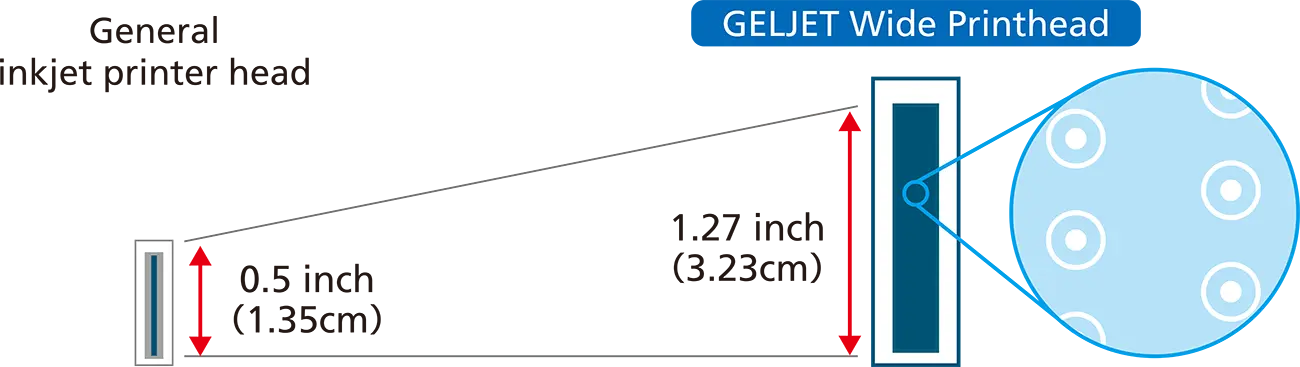
Comparison of a GELJET wide printhead and a general inkjet printer head
3. GELJET BT System
- Reduces paper wear, deflection, and jams
- Supports various paper types, including envelopes and pharmaceutical paper bags
Since GELJET printers are equipped with GELJET wide printheads, a wide flat surface needs to be secured under the printhead. Its electrostatic paper transfer system, in which the entire surface of the paper is supported by an electrostatic suction belt, enables faster and more precise paper feeding without risk of deflection compared to the roller system commonly used in inkjet printers.
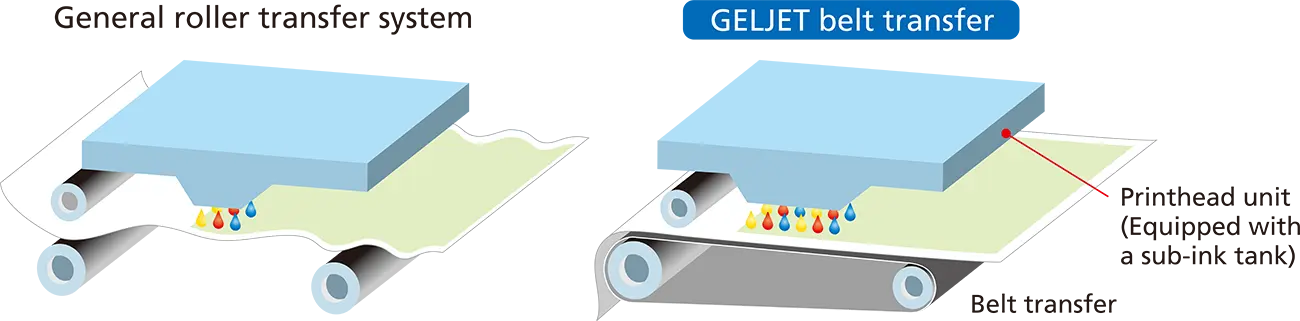
Comparison of a GELJET belt transfer system and a general roller transfer system
