
 Global
CEO Message for Sustainability
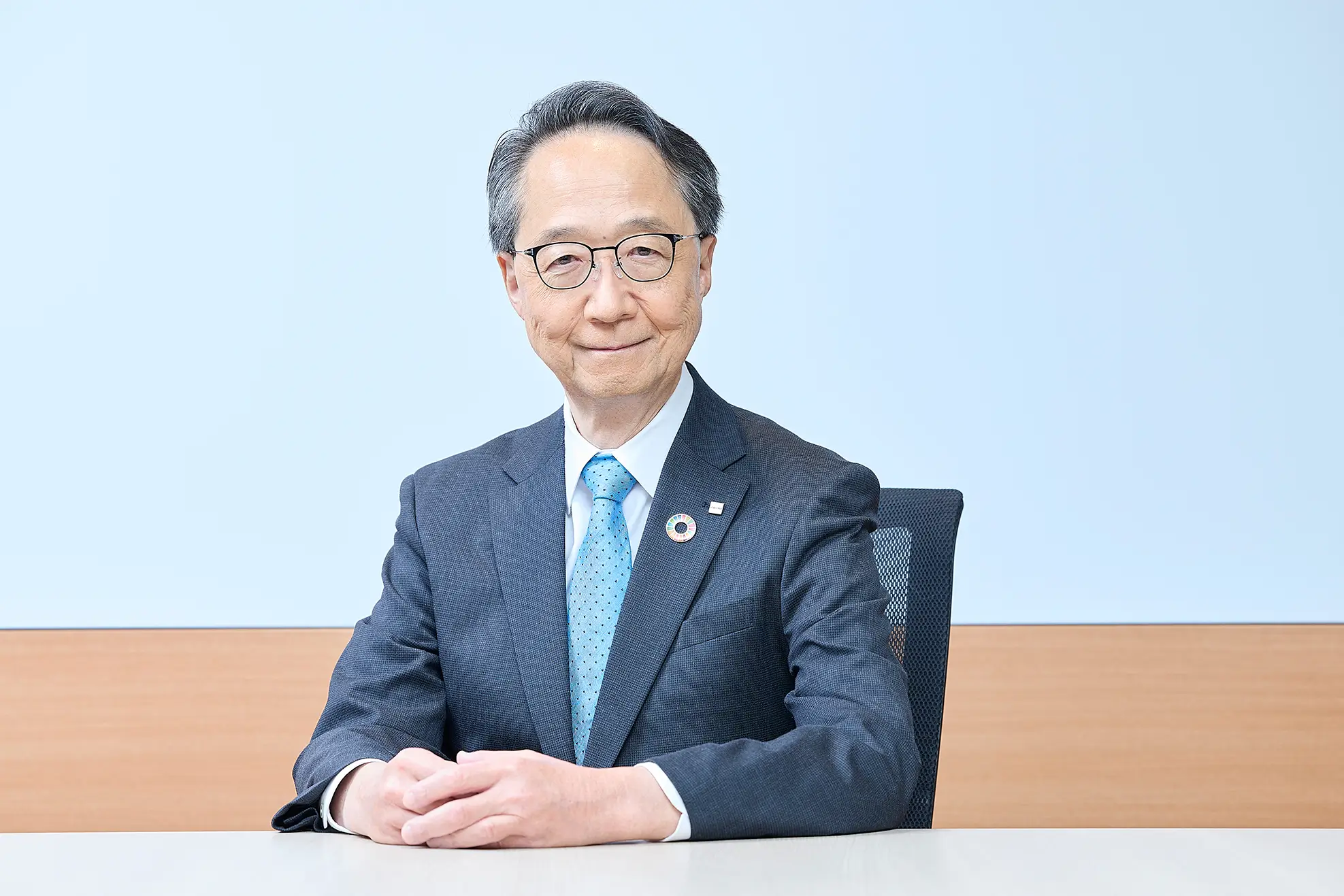
In addition to social challenges such as more frequent natural disasters caused by climate change, widening inequality, and declining birthrates and aging populations around the world, recent conflicts and geopolitical risks have further increased uncertainty over energy and resource supplies, seriously affecting the global economy and corporate management. At the same time, the rapid advancement of generative AI is transforming industry structures and creating new business opportunities, while also bringing new issues to the forefront, including disparities in AI utilization and ethical concerns.
As the business environment continues to change, sustainability-related policies and regulations are also evolving. While some regions are seeing revisions to ESG policies, regulatory simplification, and a slowdown in environmental investments, companies are also being held to higher and more rigorous standards through mandatory disclosures and due diligence relating to climate change and human rights, as well as the development of AI-related legislation. Sustainability initiatives have become a critical management issue that will shape corporate competitiveness and future growth.
We are seeing these changes in our customer discussions as well. ESG expectations remain particularly high, especially among governments across Europe and global corporations. Product environmental performance and respect for human rights throughout the supply chain are increasingly being treated as evaluation criteria alongside price, functionality, and quality. In response to these changes in society and the market, the Ricoh Group continues to strengthen initiatives that place ESG at the core of our management approach.
The Ricoh Group continues to cherish the Spirit of Three Loves, our founding principles. This expresses our commitment to enriching society as a whole through business and work, and it remains the foundation of our corporate activities today. In 1998, we also advocated the concept of environmental management. Since then, we have consistently worked to position the realization of a sustainable society and the growth of our business as inseparable goals.
In the 21st Mid-Term Management Strategy, which ran through fiscal 2025, we set forth the integration of ESG with business growth as a basic policy. We identified our material issues and established ESG targets to support our business strategy, and strengthened management-level commitment by linking progress toward these targets to executive compensation. In the environmental field, we worked to reduce greenhouse gas (GHG) emissions through the adoption of renewable electricity. We also launched our LC Transformation*1 strategy, which aims to shift to circular economy-based business models. As part of this strategy, we began offering remanufactured machines equipped with the latest security features and usability, thereby overcoming the traditional trade-off that remanufactured machines could not provide the latest features. In the area of human rights, we established human rights due diligence systems and a grievance mechanism, while working with our suppliers to manage and reduce risks throughout the supply chain.
These initiatives have also strengthened our ability to meet customers’ growing ESG requirements. We have advanced ESG initiatives not simply as a cost, but as activities that generate business growth and competitive advantage and lead to future financial value. As one result of these efforts, we have earned top-level international ESG recognition, including receiving the highest Platinum rating from EcoVadis*2 for two consecutive years.
Under the new Mid-Term Strategy beginning in fiscal 2026, we will further deepen the integration of ESG
with business growth. To translate our contribution
to the Three Ps Balance*3—the Ricoh Group’s vision for a sustainable society—into more concrete
action, we have
set new KGIs for 2030 and will work to address our six material issues and achieve our 15 ESG targets.
Going
forward, in addition to responding to customers’ ESG requirements and needs for ESG-related support, we will aim
to create new value and expand our business by investing in businesses and technologies that help reduce
environmental impact, including LC Transformation and perovskite solar cells.
We will also continue to emphasize investment in human capital, which is the driving force behind enhancing corporate value. By providing each employee with opportunities for growth and encouraging them to take the initiative in addressing social issues, we will foster an organizational culture in which everyone can experience Fulfillment through Work. We will also strive to further raise the quality of our activities through proactive disclosure and dialogue with stakeholders.
The Ricoh Group will continue to position ESG as a driving force for establishing competitive advantage and enhancing corporate value, while working steadily to achieve both the realization of a sustainable society and business growth.
Representative Director, President and CEO
Akira Oyama
- *1 LC Transformation: Ricoh's strategy for transitioning from a linear (L) economy, in which raw materials are procured, products are manufactured, and products are discarded after use, to a circular (C) economy in which resources are circulated and reused.
- *2 EcoVadis: An international sustainability ratings provider that assesses companies’ environmental, social, and governance (ESG) performance. Many global companies use its ratings when selecting suppliers.
- *3 Three Ps Balance: A state in which the sustainability of Prosperity, People, and Planet is continuously enhanced.