
 Global
Ricoh Sustainable Products Program (RSPP)

“Realize Sustainable Products/Services design which resolved Ricoh Group materiality for Driving Sustainability”
For the Ricoh Group, an ideal sustainable society is one in which the Three Ps Balance—the balance between
Prosperity, People, and Planet—is maintained. In order to create such a society, we have identified six material
issues. By looking broadly at social issues and taking on the challenge of resolving them through business, we aim
to create new markets and value propositions, expand the scope of our impact, and thereby achieve both social
development and Ricoh’s own business growth.
 More information for Ricoh Group materiality is here.
Ricoh Group's six materialities and RSPP
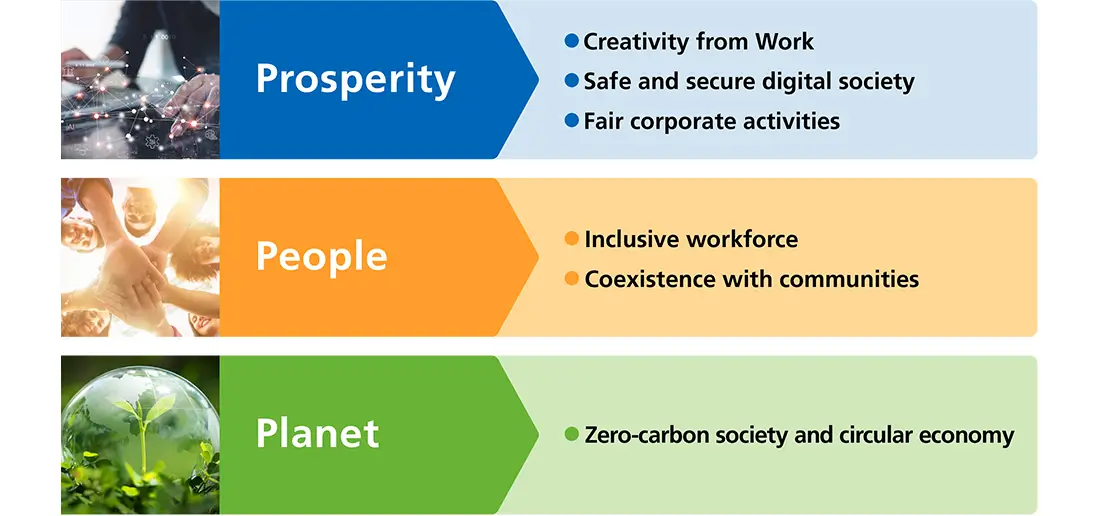
Ricoh Sustainable Products Program (RSPP) aims to deliver Sustainable Products/Services which resolved these material issues and driving Sustainable society for the customers.
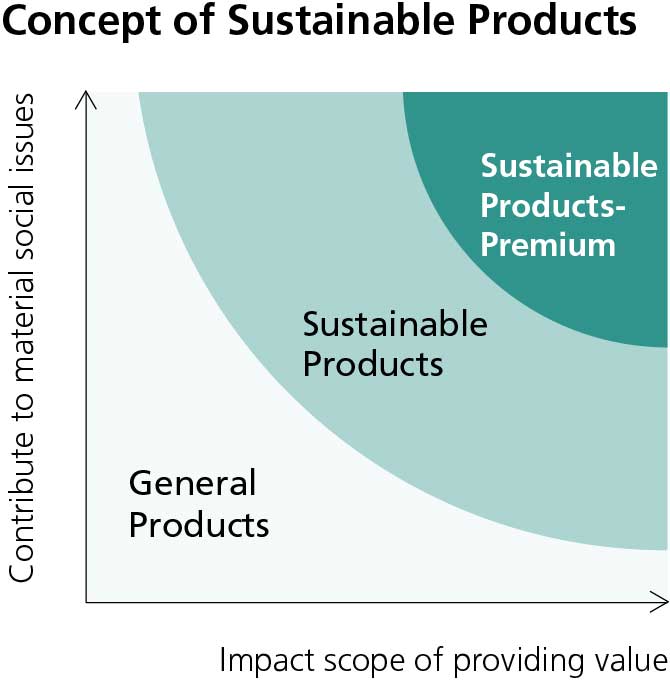
In RSPP, we assess Ricoh Group products/services by the in-house original standard and self-certificate. based on the assessment results. products/services contribute to resolve material issues are certified as “Sustainable Products” and those products judged particularly excellent are certified as “Sustainable Products-Premium”.
Ricoh Group’s “Mission Statement” in The RICOH Way is “At the Ricoh Group, we are committed to providing excellence to improve the quality of living and to drive sustainability”, which is our essential guide to each daily activity and management decision. To achieve this “Mission Statement”, we assess products and services by our own strict criteria, and certify sustainability performance and feature by ourselves in “Ricoh Sustainable Products Program”.
Ratios of the products complying with the RSPP rank
| FY1522 | FY2023 | FY2024 | FY2025 | |
|---|---|---|---|---|
| Ratios of the products complying with the RSPP rank(%) | 100 | 100 | 100 | 100 |
RSPP: Product assessment criteria
In “Ricoh Sustainable Products Program”, individual products and services are assessed based on criteria at the seven assessment axis, namely, (1) Energy Efficiency, (2) Resource Efficiency, (3) Pollution Prevention, (4) Comfort, and (5) Usability (6) CSR (7) Biodiversity Conservation. Shown below is the overview of each assessment axis and the conditions for multifunction printer rank certification:
Seven assessment axis
| Assessment axis | Overview |
|---|---|
|
Decarbonization 1) Energy Efficiency 2) Carbon footprint of product (CFP) |
Evaluates the extent to which greenhouse gas (GHG) emissions across the entire product life cycle (Life Cycle Assessment: LCA, Carbon Footprint of Product: CFP) are reduced, in addition to improvements in energy saving performance such as reduced TEC values* and sleep mode power consumption during product use. * Typical electricity consumption measured by the methods specified by the ENERGY STAR® Program requirements. |
| Resource conservation |
Evaluates the volume of resources* that are used in products and packaging has been reduced, such as through downsizing, lightweighting of products and the use of recycled materials. * New resources extracted from the Earth |
| Pollution Prevention | Pollution Prevention Evaluates how the use of chemical substances that have an environmental impact are taken into consideration in product design, in accordance with regulations such as the European RoHS Directive and REACH, as well as voluntary standards including environmental labels. |
| Comfort | Evaluates whether the impact of a product on its surroundings varies from continued use e.g. noise and emissions (dust, TVOC, UFP etc.). |
| Usability | Assess whether a product possesses a function to reduce its environmental impact and specific accessibility features, and whether environmentally-friendly settings such as sleep mode can be easily accessed etc. |
|
CSR (Corporate Social Responsibility) |
Evaluates whether corporate ethics, human rights, and environmental considerations are appropriately addressed in business activities and across the supply chain, and whether initiatives aligned with Ricohʼs CSR/ESG policies and international frameworks (e.g. RBA) are implemented. |
|
Biodiversity Conservation (Procurement of paper products using sustainably sourced wood raw materials) |
Evaluates whether wood raw materials are procured in a legal manner, with due consideration given to the sustainability of their places of origin from environmental and social perspectives. |
Product rank certification conditions
| Product rank | Product rank certification conditions |
|---|---|
| Sustainable Product | Rank to be given to products which can comply with government / green public procurement standard / main environmental label etc. in order to resolve Ricoh Group materiality. |
| Sustainable Product-Premium | Rank to be given to Products that have excellent performance (industry's 'Top' or 'First' feature(s) etc.) in one of the criteria at least, and satisfy the Sustainable Products requirement as well. |