
 Global
Event Report
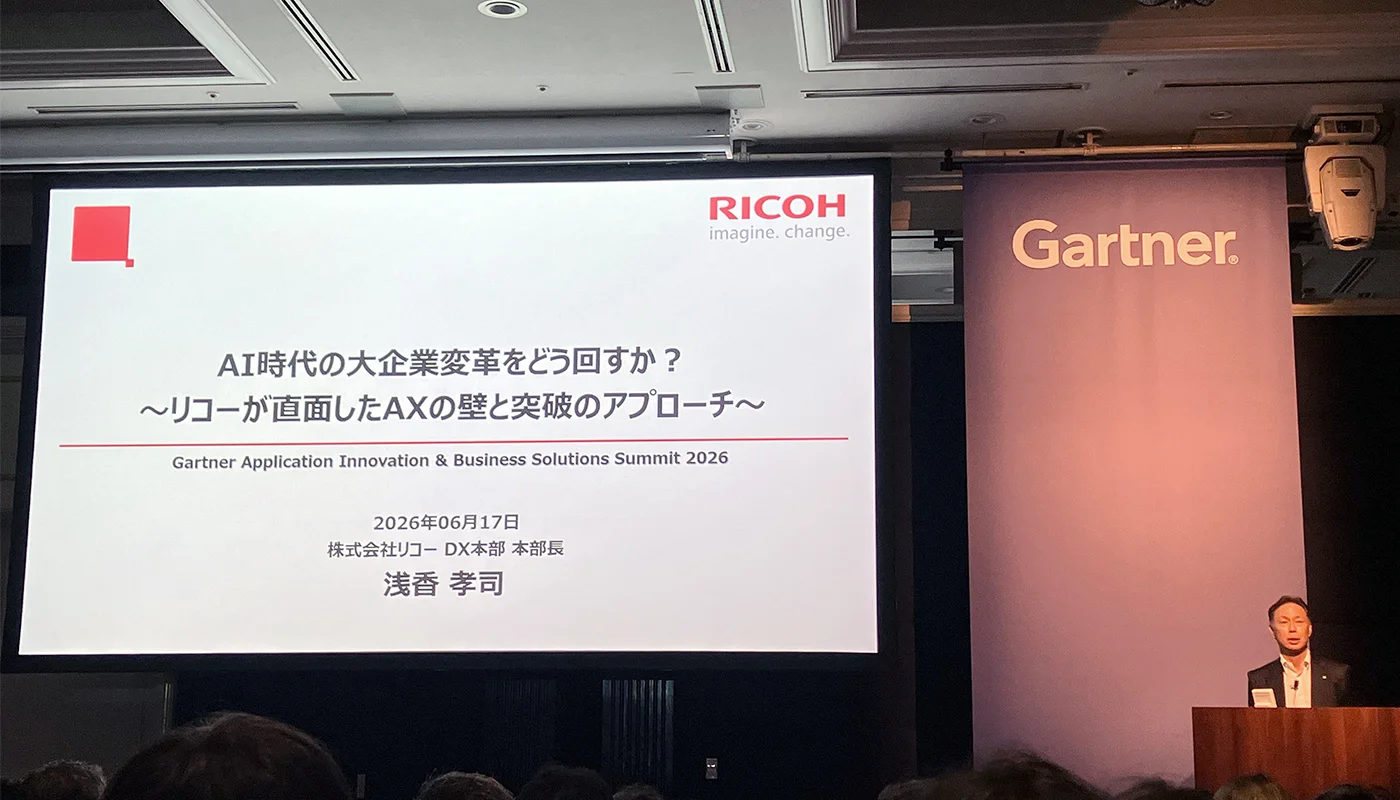
Many organizations are investing in digital transformation (DX) and
generative AI, yet few are achieving the business outcomes they expected.
According to Takashi Asaka, Head of DX Division, Ricoh Company, Ltd., the
challenge often lies not in AI itself, but in business processes that were
never designed with AI in mind.
Speaking at the Gartner Application
Innovation & Business Solutions Summit 2026 in Tokyo, Asaka shared how
Ricoh has approached AI Transformation (AX) through a process-first
strategy. Drawing on Ricoh's own transformation journey, he explained how
AI-ready processes, human-AI collaboration, and purpose-driven AI
deployment can maximize Return on AI (RoAI) and deliver measurable
business outcomes.
Ricoh has been helping transform the workplace for decades. Since
declaring its shift to a digital services company in 2020, the company has
continued to promote DX and AI initiatives to realize Fulfillment through
Work.
At the beginning of his session, Asaka addressed the current
state of DX and AI adoption in Japan. He cited a Gartner press release*,
stating that Japanese companies are not meeting CEOs' expectations for key
digital initiatives compared with their global counterparts.
He added
that, even in the adoption of generative AI aimed at improving
productivity, only a limited number of companies are delivering results
beyond expectations.

Ricoh recognized early on the importance of establishing business
processes as a foundation for DX and AX. The company promoted Business
Process Management (BPM) initiatives and systematized them as “process
DX.”
This approach started from the idea of eliminating workplace
stress caused by tedious, repetitive, and error-sensitive tasks through
the use of digital technologies.
In recent years in Japan, Ricoh has
established a Process DX Center of Excellence (CoE) to support digital
utilization in the field. The company has also invested in developing
business analysts and citizen developers.
These initiatives have
helped establish a frontline-led approach to process DX across the
company.
However, Asaka also pointed out a risk in field-driven transformation.
When
teams introduce AI independently, it can create inefficiencies across
interconnected business processes. It can also lead to increased
AI-related costs.
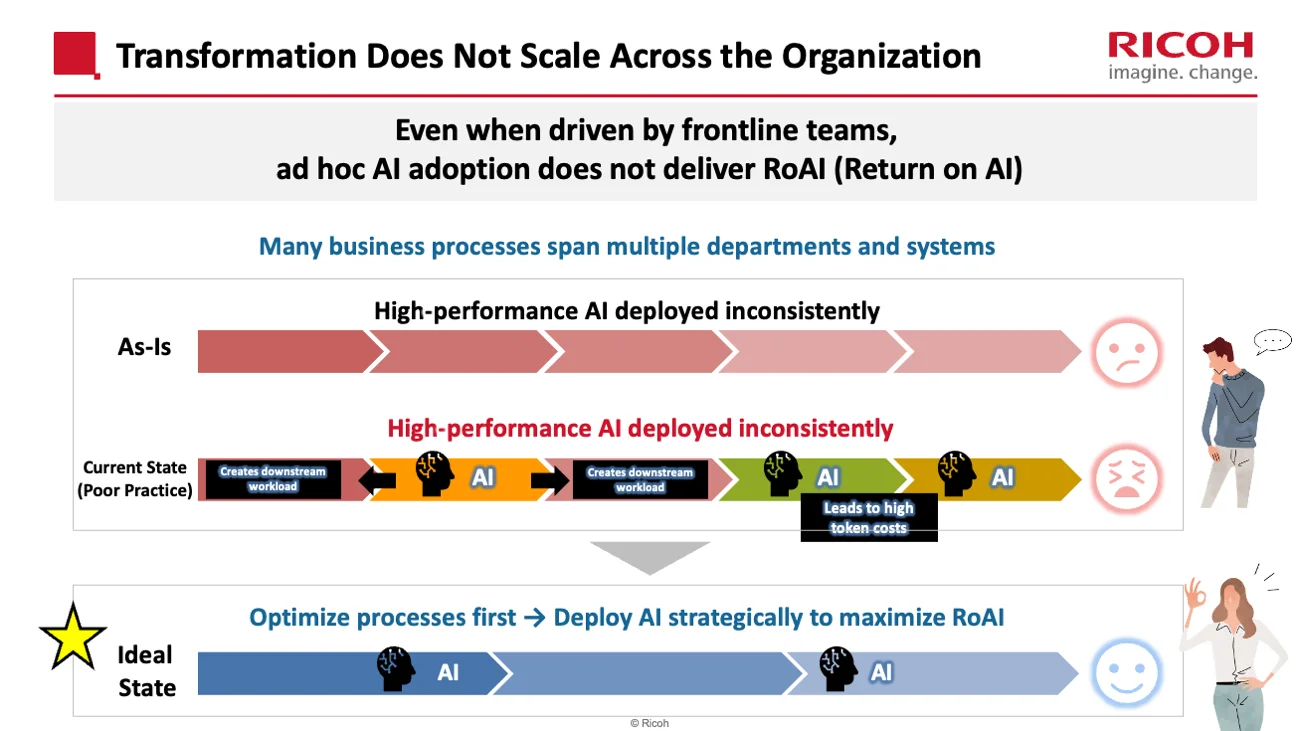
Rather than adopting AI on an ad hoc basis, Asaka emphasized the
importance of combining end-to-end process optimization with
purpose-driven AI deployment. This approach enables organizations to
maximize RoAI (Return on AI).
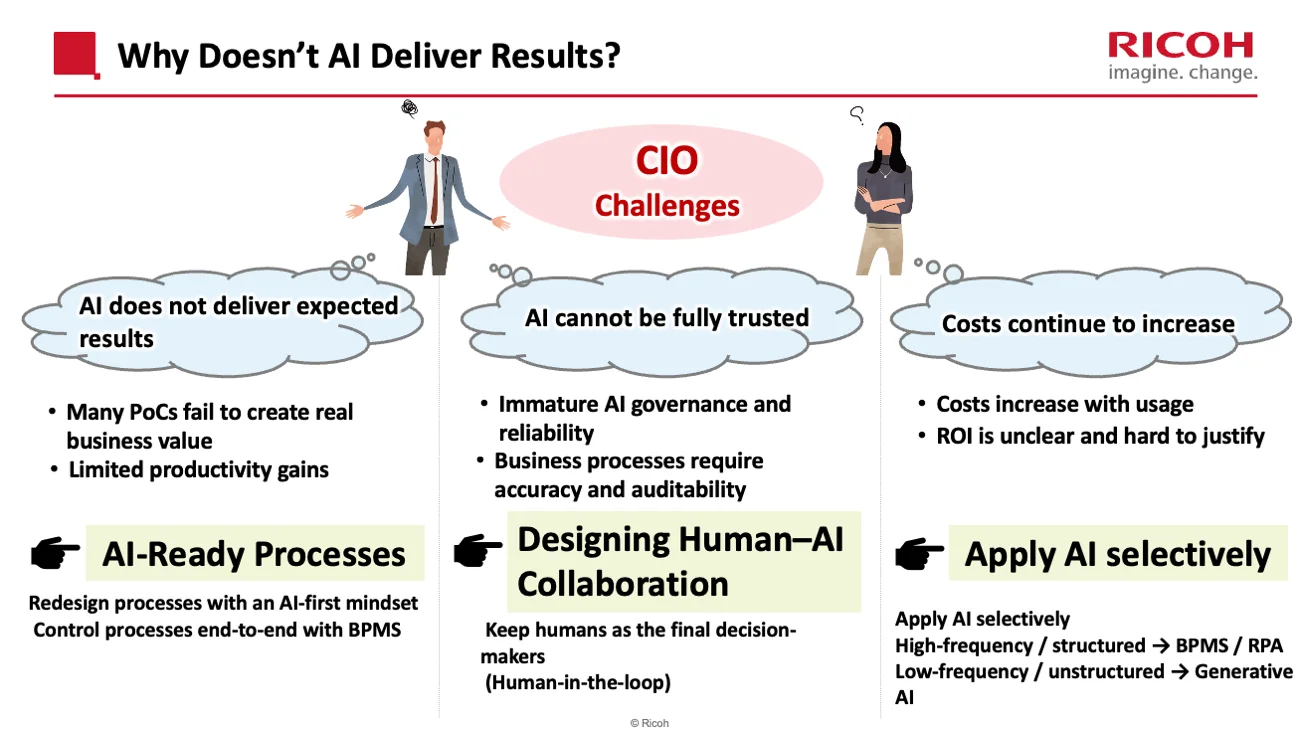
He outlined three key elements of this
approach:
Building AI-Ready Processes in Practice
An AI-ready process is designed with AI in mind from the outset.
For
example, in its procurement operations, Ricoh redesigned its
procure-to-pay (P2P) processes. The company standardized workflows and
expanded automation to create a fully orchestrated end-to-end process.
Built on this foundation, Ricoh integrated AI into System of Record (SOR) environments that handle large volumes of transactions. This improved data processing efficiency and reduced processing time.
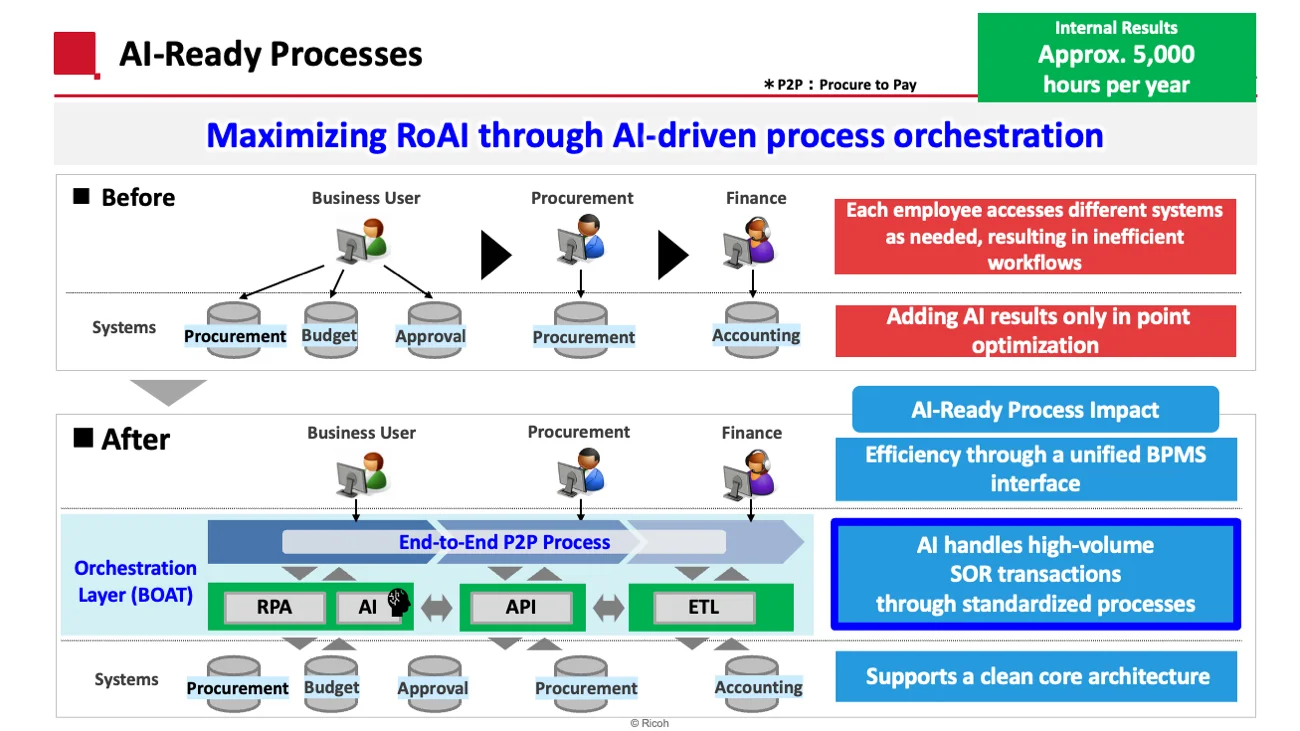
At the same time, it reduced workload and addresses many of the workplace challenges associated with tedious, repetitive, and error-sensitive tasks. The standardized processes also support clean core system operations, enabling AI to be integrated without extensive customization of core business systems.
Ricoh uses Axon Ivy as its process orchestration platform. Positioned as a Business Orchestration & Automation Technology (BOAT) solution, it has been adopted by more than 750 companies worldwide and is planned for release in Japan.
Designing Human–AI Collaboration and Purpose-Driven AI Deployment
While AI can efficiently process large volumes of data, business
operations still require accuracy, accountability, and auditability.
Asaka
noted that many organizations have concerns about the reliability and
governance of AI. To address these challenges, Ricoh adopts a
“human-in-the-loop” approach, in which humans remain the final
decision-makers and retain accountability for outcomes.
As an example of human-AI collaboration, Asaka shared an initiative to
improve invoice processing within Ricoh Black Rams Tokyo, Ricoh's
professional rugby team.
The team faced challenges in collecting
invoices and determining appropriate account categories. To address these
issues, Ricoh developed an application that centralizes invoice management
and integrates AI-OCR, AI agents and document intelligence capabilities.
For example, when the system reads a product name such as “Black Rams
Tokyo'47 CLEAN UP Black,” the AI agent identifies it as a cap and selects
the appropriate account category for input into the procurement system.
This
approach shifts human involvement toward final review. As a result, it
reduces workload and shortens processing time.
Asaka emphasized that different AI technologies are suited to different purposes. Selecting the right AI for the right task within a human-AI collaborative process is essential to maximizing RoAI.
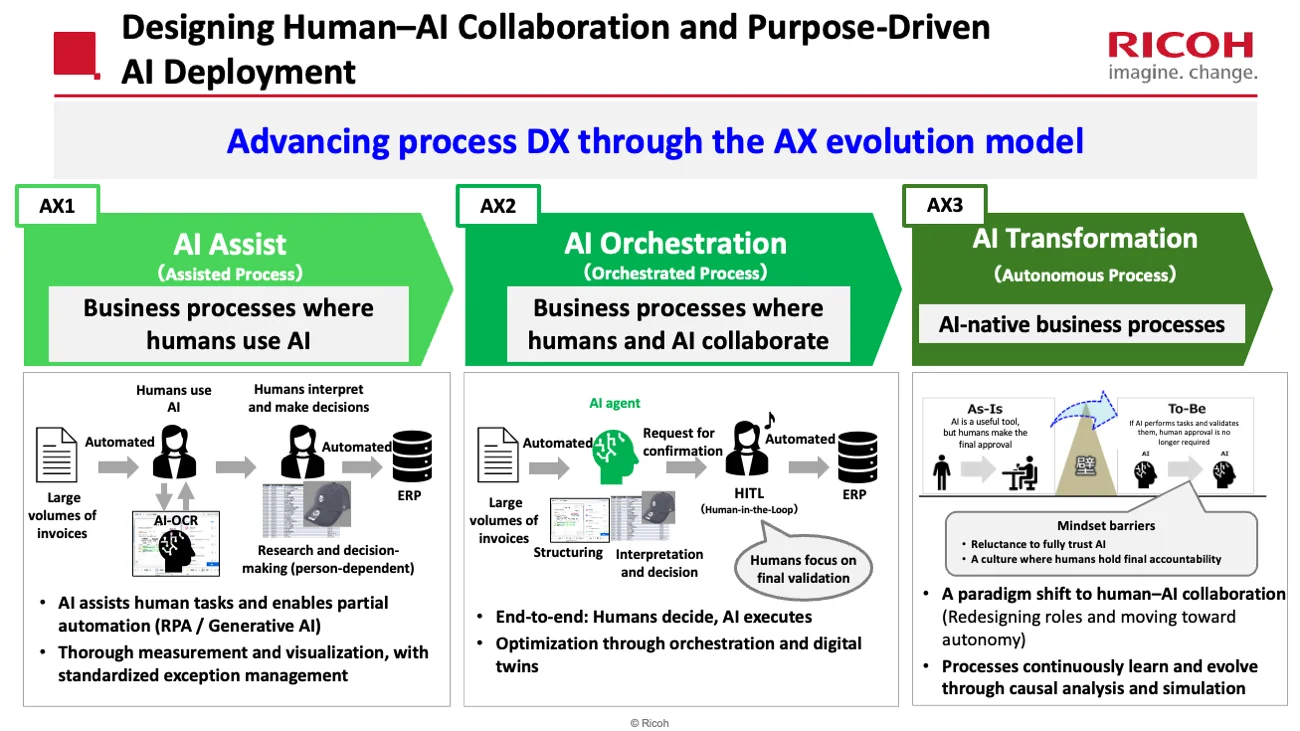
This approach improves transparency, ensures explainability, and helps manage AI-related costs that are often difficult to visualize.
Ricoh also applies AI to the design and improvement of business
processes.
The company uses a process modeling AI that generates
workflows from conversations, as well as an AI that supports process
optimization consulting. These tools significantly improve efficiency.
In
addition, Axon Ivy offers development support features such as “Smart
Core” and “Smart Workflow.” These capabilities accelerate the transition
from process design to implementation.
Asaka explained that Ricoh has
continuously invested in developing business analysts. By combining their
expertise with AI, the company enhances productivity and shortens the time
required to deliver results.
He emphasized that these achievements
are built on Ricoh’s accumulated process DX practices. An AI-ready
foundation built through process optimization is essential for maximizing
RoAI.
Advancing Competitiveness in the AI Era
Asaka concluded by reflecting on the nature of business processes in
Japanese companies.
These processes are often detailed and complex.
At the same time, this precision represents a strength.
By optimizing
business processes and designing effective collaboration between people
and AI, organizations can enhance their competitive advantage in the AI
era.
Through its process-first approach, Ricoh aims to create better
ways of working and help realize its purpose of Fulfillment through Work.
As “Client Zero,” Ricoh will continue applying what it learns through its internal transformation to help customers create greater value.
-
*GARTNER is a trademark of Gartner, Inc. and its affiliates.


