
 Global
Ricoh's Initiatives
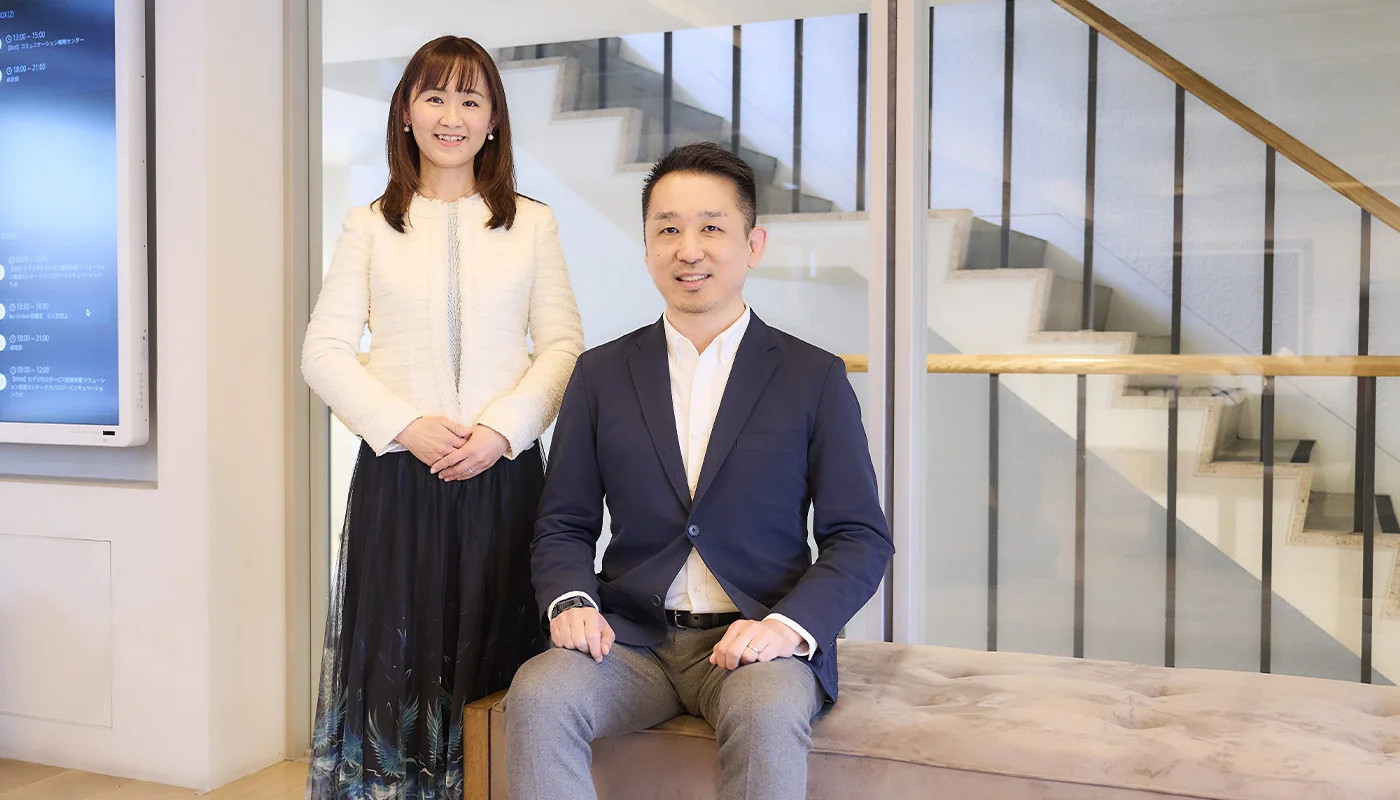
As AI adoption and digital transformation continue to drive efficiency and a stronger focus on performance, companies are increasingly required to differentiate themselves and deliver added value to attract and retain customers. In response, Ricoh launched an internal transformation initiative called the Experiential Value Enhancement Program, designed to strengthen customer-centric thinking and enhance the quality of experience it delivers. We spoke with Daisuke Taniuchi of the Digital Strategy Division, who leads the program, and Mayumi Yamanaka of the Finance Division, whose team participated in the initiative, about its impact and future outlook.
Estimated reading time: 7 minutes
In the Ricoh Group Integrated Report 2025, the chief technology officer positioned experiential value as a concept that focuses on how customers feel when using its services. It is gradually becoming a shared guiding principle across the organization. This driver of competitiveness goes beyond functionality and efficiency. It reflects how customers feel when using our products and services —whether they find them essential, memorable, and worth recommending. Daisuke Taniuchi, who heads the Digital Service Design Department of Ricoh’s Digital Strategy Division, explains how the concept emerged.
“For quite some time, Ricoh faced challenges in expanding its digital services. We realized that simply improving features wouldn’t be enough to retain or attract customers. We concluded that it is essential for the Ricoh Group as a whole to continue enhancing experiential value to create experiences that genuinely delight customers and leave a lasting impression.”
A challenge particularly in development environments was that discussions often lost sight of the users who ultimately experience the value. With AI transforming workstyles and business models and value demands evolving, Taniuchi says, “It’s crucial to continually examine the value users actually experience.”
Daisuke Taniuchi
Head of Digital Service Design Department, Digital Strategy Center, Digital Strategy Division
More than 2,000 Ricoh employees in Japan have already completed internal training in design thinking, a user-centric approach to creating and enhancing the value of products and services. The next step was for employees to apply what they had learned and translate it into real business outcomes. In response, Taniuchi and his team in the Digital Service Design Department launched the Experiential Value Enhancement Program, designed to maximize experiential value by linking training with real-world practice. The program certifies leaders of customer-facing projects as Experiential Value Leaders. Digital Service Design Department members work alongside them to provide ongoing support as initiatives get underway.
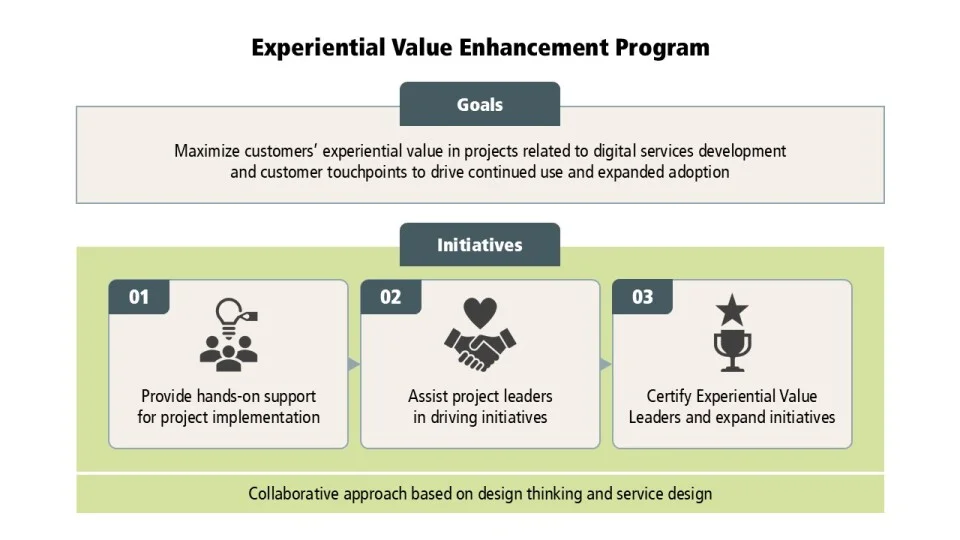
To be certified as an Experiential Value Leader, an individual must be a project leader with responsibility and authority to achieve project goals, and actively apply design thinking or similar approaches to maximize the value experienced by customers and users. The program also aims to foster behavioral change companywide by sharing the success stories of Experiential Value Leaders as role models across the organization.
Taniuchi explains, “We also emphasize broadening experiential value. Rather than simply increasing isolated examples within each business area, we aim to connect initiatives across teams so experiential value can be enhanced comprehensively at every customer touchpoint. We ultimately want leaders to team up and support customers in diverse ways, so we try to get behind as many different projects as possible.”
One project supported by the program focused on improving the user experience (UX) and interface (UI) of Accounting Navigator, an AI-enabled internal tool developed to streamline inquiries to the accounting department. Mayumi Yamanaka, who leads the Planning Section in the Finance and Accounting Planning Department of the FSC of the Finance and Accounting Division, led Accounting Navigator development in collaboration with the Workflow Innovation Center. The tool was launched in April 2024.
The project team comprised members from Finance and Accounting Planning and business analysts and developers from the Workflow Innovation Center. It put users first from the outset. The team incorporated feedback from pre-launch user surveys and adopted a small-start approach, testing effectiveness and adjusting direction before rolling the tool out companywide. After the launch, functionality was refined through weekly meetings. But eight months later, a follow-up user survey revealed extensive concerns about usability.
Yamanaka reflects that, “We received a lot of feedback on UX/UI issues. People said the controls were confusing, the question field was too small, and it was difficult to tell whether the tool was processing a search or had frozen. We thought we’d reviewed the specifications from the user’s perspective before release, but we hadn't fully appreciated how people would actually experience it. Through the program’s hands-on support, we were able to identify these gaps and translate them into concrete improvements. That experience made us keenly aware of the need to rethink how we define and deliver user value.”
Yamanaka moved quickly to drive improvements in light of the issues, seeking assistance from Taniuchi and his team. With support from the Experiential Value Enhancement Program, she relaunched the effort to improve the UX/UI from a user-first perspective.
First, the team reexamined the survey results and reorganized the issues from the standpoint of process digital transformation. It then conducted usability tests to observe how first-time users naturally interacted with the Accounting Navigator. In the initial session, Taniuchi served as moderator. Participants first completed assigned tasks using the tool as they normally would. In the second round, they repeated the same tasks while explaining where they hesitated or became confused, and what they thought and felt at each step. This approach allowed the team to observe users’ emotions and thought processes during use.
Recalls Yamanaka, “Because we were so familiar with the system ourselves, we failed to notice where users would stumble or even stop altogether because they didn’t know where to enter information. It was both eye-opening and refreshing to realize what we'd overlooked. We reaffirmed the importance of being user-centric.”

Mayumi Yamanaka
Planning Section Leader, Finance and Accounting Planning Department, Financial Solution Center, Finance and Accounting Division
The team clarified its improvement strategy based on usability test results and drawing on frontline feedback and actual usage data. It revised wording and layout, prioritized key information, and streamlined access to FAQs. The team implemented and tested these changes in short cycles. A second usability test was then conducted, this time with Yamanaka serving as moderator. The team released the updated Accounting Navigator three months after the project began.
The revised tool now enables more intuitive operation and easier access to information. In a post-revamp survey, a higher percentage of respondents said it was easier to understand and use. Comments included appreciation for its usefulness in resolving accounting-related questions, a desire to continue using it, and recommendations to others. Users also described it as more convenient and helpful, and such positive feedback boosted team morale.
The program also brought positive change to the team. Yamanaka says, “We received support at the right time and at the right level of detail, which allowed us to build practical expertise through hands-on experience. I learned much from conducting usability tests. I feel confident that we can apply this experiential value approach to other UX/UI improvement initiatives.”
Another major outcome was the team’s shared commitment to thinking from the user’s perspective. Yamanaka notes, “Many factors influence decisions about features, but we can now return to a common standard, which is what’s best for the user. That’s made decision-making much easier.”
Through the project, Yamanaka also came to appreciate the potential of Ricoh’s cross-departmental collaboration, in which members work alongside one another to drive improvement. She explains, “To enhance UX/UI, we brought together members from more departments than in our previous process digital transformation initiatives, including the DX Solution and Digital Service Design Departments. Strong teamwork enabled us to bolster experiential value. This kind of cross-departmental collaboration is a strength of the Ricoh Group. Our model of combining process digital transformation with experiential value enhancement can also apply to other areas. By putting mechanisms in place to encourage broader adoption, I believe we can establish this approach as a standard model across the Group.”
Taniuchi also expressed his desire to expand experiential value initiatives more rapidly, using success cases. “We hope to accelerate horizontal expansion by distilling our approach into practical templates that other areas can easily adopt. We want to build a platform —something like an open-source environment—where people can create and share best practices.”
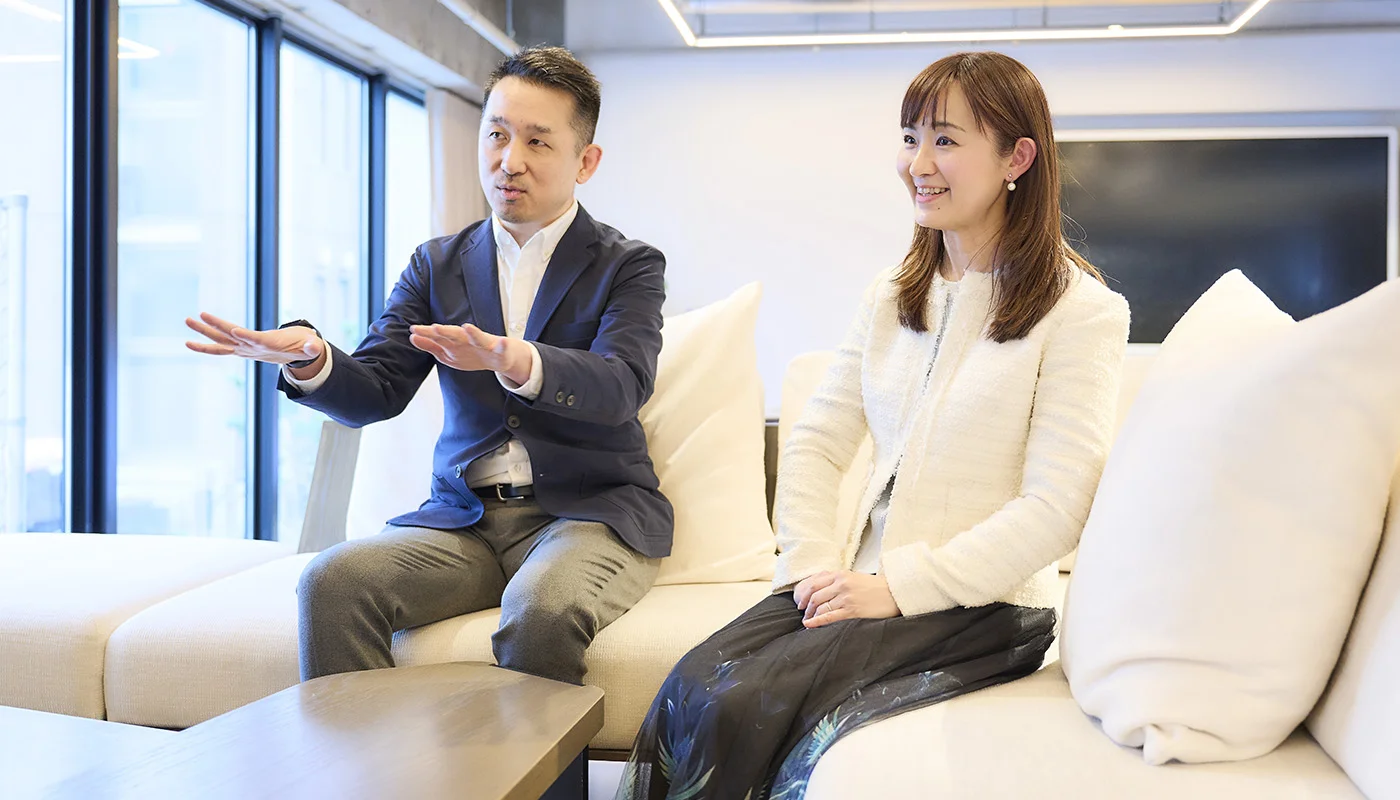
The cross-departmental initiative has proven fulfilling to both leaders. Taniuchi says, “I find great satisfaction in joining frontline projects and working with team members to enhance experiential value for customers. Experimenting and refining ideas together is genuinely enjoyable. Working with passionate leaders like Yamanaka and innovative, customer-centric team members, and moving swiftly toward goals is incredibly rewarding.”
Yamanaka also finds fulfillment in bringing together ideas and expertise from different departments to pursue what she considers true experiential value. At the same time, learning from other departments and feeling her own growth have strengthened her motivation. “I hope more people can experience the enjoyment and satisfaction I felt. I want to expand the circle of colleagues who can share that experience. By spreading these efforts more widely, starting within my own organization and extending them across the Ricoh Group, we can enhance value groupwide. That process itself gives me fulfillment through work.”
Yamanaka adds that, “Enhancing experiential value brings together the Ricoh Way values of CUSTOMER-CENTRIC, TEAMWORK, and GEMBA. This project reaffirmed for me that when these values come together, they create true fulfillment through work.”
In the age of AI, Ricoh will continue striving to create experiences that truly resonate with customers, keeping them at the heart of every initiative.


