
 Global
Enterprise Knowledge Management Based on LLMs
-
*The service incorporating this technology is currently available in multiple markets across Asia-Pacific (APAC) region
Background
As enterprises grow, managing vast and fragmented knowledge assets has become a critical operational challenge. Corporate information today spans a wide spectrum:
- Structured data stored in databases and Enterprise Resource Planning (ERP) systems
- Semi-structured content such as documents, emails, and forms
- Unstructured insights—including key observations, decisions, and contextual information that help users make better decisions—embedded in meeting notes, chat logs, Standard Operating Procedures (SOPs), technical drawings, customer support tickets, and compliance records
Traditional Knowledge Management (KM) systems rely on manual sorting and keyword-based searches, lacking the semantic understanding and dynamic reasoning needed to unlock the true value of enterprise information. Meanwhile, general-purpose LLMs, though powerful, are prone to generating incorrect outputs and may have limited access to private enterprise data.
There is a pressing need for an integrated solution that combines robust enterprise knowledge governance with AI agent-driven knowledge delivery — one that can unify scattered information, enable precise and context-aware insights and automate complex workflows to drive operational efficiency and innovation.
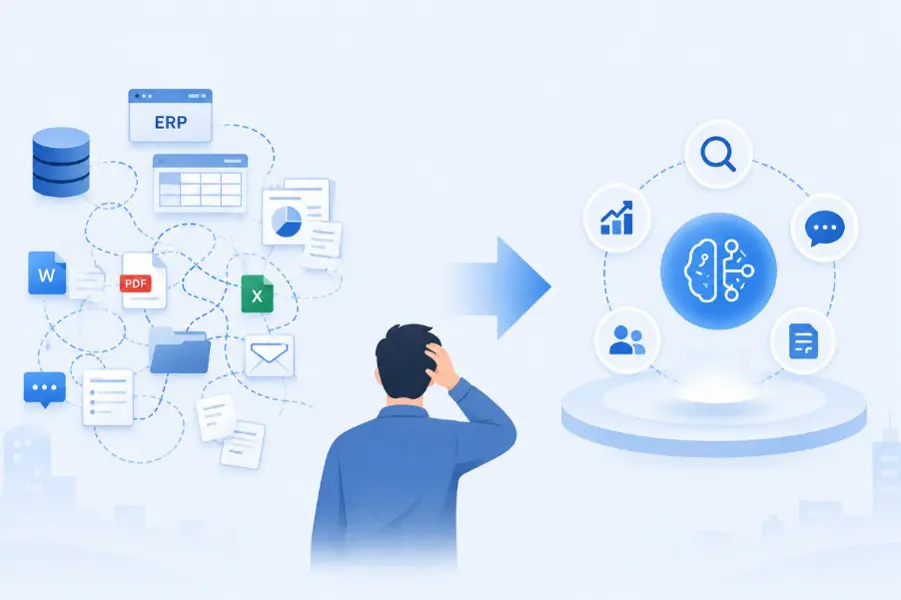
Transforming Enterprise Knowledge into Actionable Insights
Solutions
RICOH InnoAI Hub is an enterprise knowledge management platform built on LLM-powered governance and AI agent-driven automation. It unifies scattered structured and unstructured enterprise data into a centralized, intelligent knowledge base — enabling employees and teams to instantly find, understand, and act on critical information.
The platform delivers two core capabilities that directly benefit users:
- Knowledge Governance: All enterprise knowledge — from documents and databases to emails and meeting records — is automatically ingested, organized, and secured into a searchable, structured repository. Users no longer need to search across multiple systems to find what they need.
- AI Agent Delivery & Automation: Intelligent AI agents activate this knowledge on demand, answering complex questions, analyzing documents, and autonomously executing multi-step business processes — from contract review and report generation to data analysis and customer inquiries.
Together, these capabilities transform fragmented enterprise knowledge into searchable, callable, and decision-enabling intelligent assets — bridging knowledge management with business execution.
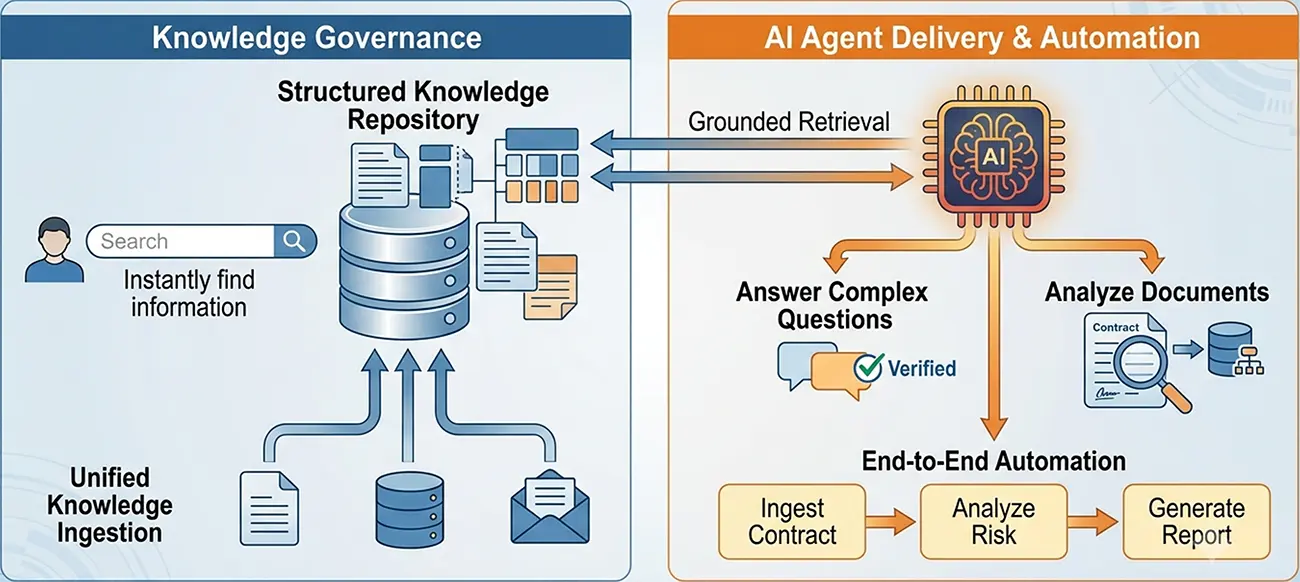
Features of RICOH InnoAI Hub
RICOH InnoAI Hub enables professionals at every level — whether, for example, after-sales engineers, project managers, or data analysts — to extract, organize, and leverage critical knowledge instantly.
By the end of FY2025, RICOH InnoAI Hub is trusted by over 1,000 customers across Hong Kong and Mainland China, with proven impact across manufacturing, finance, retail, construction, education, and professional services. From streamlining daily document processing and managing corporate policies via AI Helpdesk, to empowering legal teams with contract analysis and accelerating pre-sales, our solution is built for measurable impact at every level of the organization.
Technical highlights
RICOH InnoAI Hub is built on two complementary technology pillars: a high-performance enterprise knowledge infrastructure and a cognitive AI agent engine.
While both pillars leverage proven, industry standard technologies — including LLMs, vector databases, OCR and retrieval algorithms — our innovation lies at the system level: in how we integrate and orchestrate these components into a unified platform that seamlessly combines knowledge management, RAG applications, and workflow Agent automation, all accessible through an intuitive no code interface. This enables domain experts to build and deploy AI powered solutions without engineering support.
At its core, RICOH InnoAI Hub transforms scattered enterprise documents into intelligent, actionable assets — turning information chaos into strategic advantage.
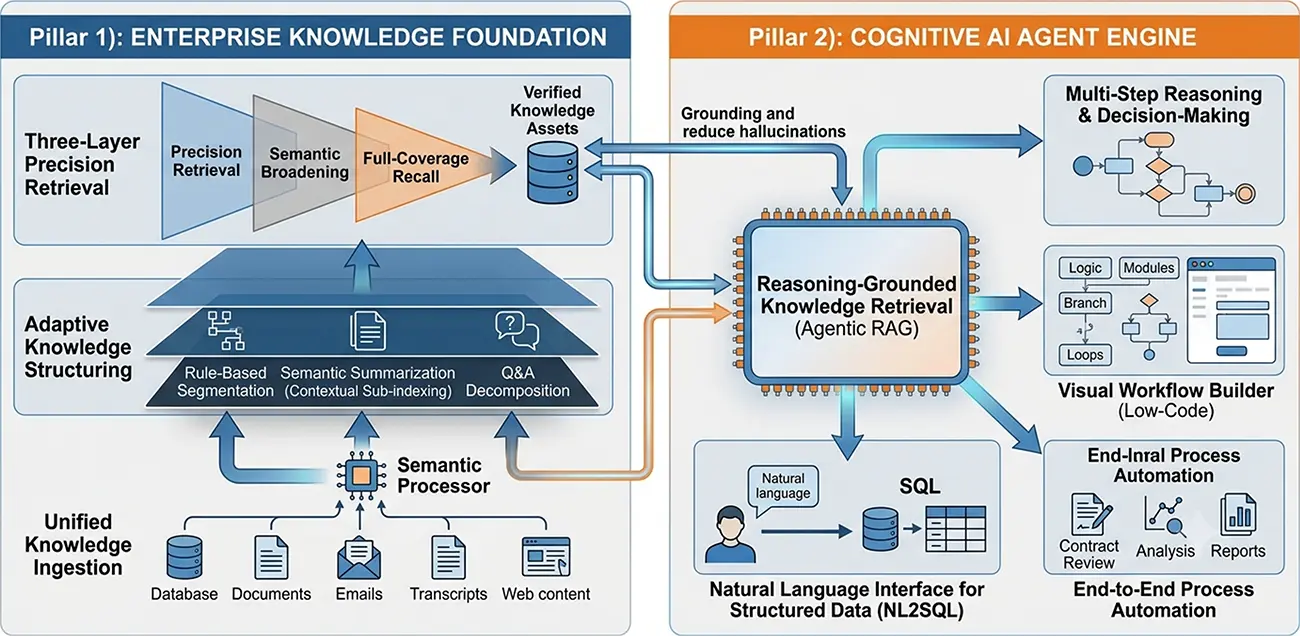
Two Complementary Technology Pillars of RICOH InnoAI Hub
1. Enterprise Knowledge Foundation
A semantically aware knowledge infrastructure designed to turn large volumes of varied enterprise data into structured, retrievable knowledge assets.
Unified Knowledge Ingestion from Multiple Sources
The platform automatically connects to and processes diverse enterprise data sources — including structured databases, unstructured documents, emails, meeting transcriptions, and web content. All information is converted into a common semantic representation that both humans and AI systems can understand and reason over, helping reduce information silos across the organization.
Adaptive Knowledge Structuring
To ensure both broad coverage and high-precision retrieval, the platform applies three complementary methods to organize and store knowledge:
- Rule-Based Segmentation: Direct segmentation for high-throughput, general-purpose knowledge processing with low latency
- Semantic Summarization: Generative summarization with contextual sub-indexing to amplify meaning and strengthen linkages between related information
- Q&A Decomposition: Transforms narrative text into structured question-and-answer pairs, delivering higher precision for conversational queries and frequently asked questions
Three-Layer Precision Retrieval
When a user submits a query, the platform applies a multi-layered retrieval strategy to ensure the most relevant and complete answer:
- Precision Retrieval: Delivers highly focused, noise-free results by filtering for only the most relevant information
- Semantic Broadening: Broadens the search to capture related knowledge and implicit user intent
- Full-Coverage Recall: Performs a comprehensive scan of the entire knowledge base to improve coverage and reduce the risk of missing relevant information
These layers are combined with semantic, keyword, and hybrid search techniques, followed by intelligent re-ranking — achieving enterprise-grade recall accuracy and full-spectrum coverage.
2. Cognitive AI Agent Engine
This is cognitive agent architecture that integrates reasoning-centric retrieval, low-code workflow orchestration, and autonomous task execution — delivering end-to-end knowledge activation and operational automation.
Reasoning-Grounded Knowledge Retrieval – Agentic Retrieval-Augmented Generation (RAG)
At the core of the AI agent is a retrieval-augmented reasoning engine that tightly integrates real-time knowledge retrieval with LLM-based reasoning. Before generating any response, the agent retrieves and cross-checks relevant information from the enterprise knowledge base – helping ground responses in relevant enterprise data, which reduces the risk of hallucination. This enables the agent to leverage enterprise data for deep, domain-specific reasoning.
Multi-Step Reasoning and Autonomous Decision-Making
Equipped with hierarchical logical inference, the AI agent can decompose complex business tasks into step-by-step reasoning chains. It supports conditional branching, iterative analysis, and causal reasoning — supporting analysis and human decision-making across intricate enterprise scenarios such as contract analysis, risk assessment, and multi-source report synthesis.
Visual Workflow Builder (Low-Code)
A visual, low-code workflow designer with more than 15 built-in functional modules allows business users to construct AI-powered automation workflows without writing any code. Complex business logic — including conditional branches, loops, and integrations with external tools — can be built visually and deployed as intelligent, executable workflows.
End-to-End Business Process Automation
The platform automates complete business processes from start to finish, including contract review, document analysis, information extraction, and report synthesis. The AI agent executes configured workflow steps with appropriate human oversight, reducing manual intervention and minimizing operational risk across the entire process lifecycle.
Natural Language Interface for Structured Data (NL2SQL)
Business users can query structured databases using plain, conversational language. The system translates natural language questions into executable database queries, enabling anyone — regardless of technical background — to access and analyze structured data independently. This democratizes data access across the organization.
Ricoh's vision
LLM-based enterprise knowledge management has the potential to fundamentally transform how organizations operate — reducing operational costs, streamlining workflows, and dramatically improving the speed and quality of decision-making. For individual employees, it means faster access to the right information, less time spent on repetitive tasks, and greater capacity to focus on meaningful, high-value work.
Ricoh brings decades of deep expertise in document processing, information management, and AI technologies to this challenge. This accumulated know-how — spanning Optical Character Recognition (OCR), Document Intelligence, Workflow Automation, and Enterprise AI — forms a unique foundation that underpins RICOH InnoAI Hub's ability to handle the full complexity of real-world enterprise knowledge environments.
Building on this foundation, Ricoh's mission is to help enterprises digitally transform their knowledge operations, unlock the full value of their internal information assets, and drive sustainable business growth. Ricoh continues to expand its capabilities through co-creation with partner organizations — jointly developing and demonstrating next-generation applications of this technology across industries.


