
 Global
Inkjet-Printed Perovskite Solar Cells
Background
The industrial sector is working to set greenhouse gas reduction targets and formulate and publish roadmaps aimed at realizing a zero-carbon society. Solar power generation systems and the solar cells that support them are being positioned as a means of achieving this.
The installation of conventional silicon solar cells is sometimes regarded as problematic. For example, the installation site must be on level ground, and the building itself must be strong enough to bear the weight of the solar cells installed on the roof.
On the other hand, perovskite solar cells are thin, lightweight, and flexible next-generation solar cells that can generate energy efficiently even in poorly illuminated areas and when installed vertically. Therefore, these cells are expected to become a new means of generating energy by making effective use of walls and other vertical surfaces, which allows them to be installed on roofs of buildings with low load-bearing capacity, conditions in which it is difficult to adopt conventional silicon solar cells.
Perovskite solar cells with these features are also expected to be utilized as stand-alone power sources for IoT (Internet of Things ) devices.
However, for perovskite solar cells to become widely used, low-cost, mass production technology is essential, as is the ability to customize the size and design to fit roofs and wall surfaces.
Solutions
Ricoh has developed a film formation technology for perovskite solar cells that instead of requiring laser processing or vacuum processing applies all the functional layers using its proprietary organic photoconductor and inkjet technologies.
This technology will enable the high productivity and low-cost production of perovskite solar cells. Furthermore, Ricoh believes it can be applied to a variety of applications by taking advantage of the elements of inkjet technology to impart design features and cell size customization.
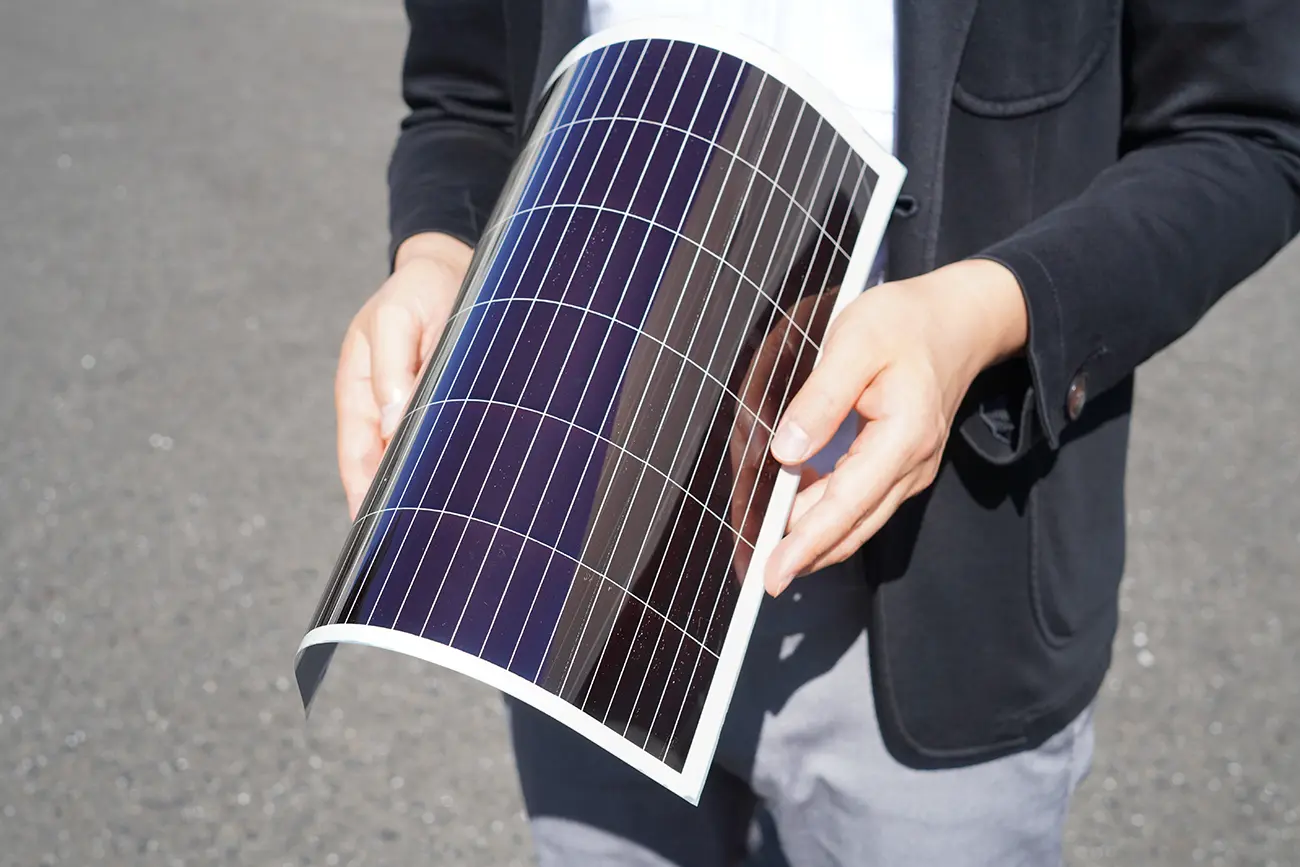
Perovskite solar cells manufactured with inkjet technology
Technical highlights
1. Technology to realize high energy conversion efficiency and high durability
By incorporating the organic photoconductor technology it has pioneered over the years in developing multifunction printers, Ricoh became the first in the world to market a solid-state dye-sensitized solar cell that generates electricity even in weak indoor light.
Ricoh will use the organic semiconductor, formulation design, module design, and encapsulation technologies gained through this research and development to achieve perovskite solar cells that demonstrate high energy conversion efficiency and high durability.
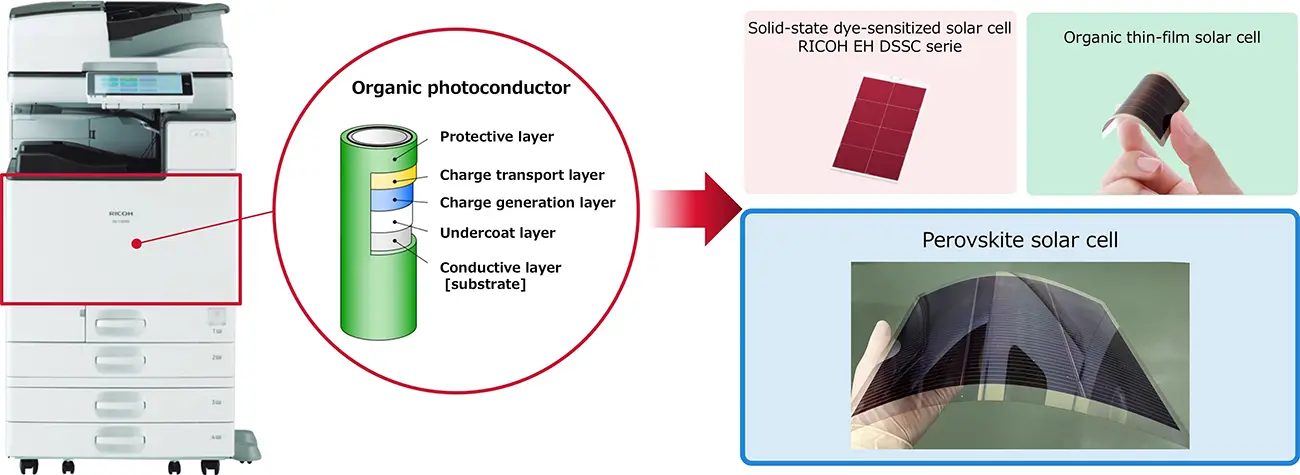
Application of organic photoconductor technology used in multifunction printers to perovskite solar cells
2. Perovskite solar cell manufacturing technology that achieves high productivity at low cost, flexible design creation, and customized sizes
Perovskite solar cells are fabricated by depositing functional layers—electron transport, perovskite, hole transport, and counter electrode layers—on a transparent electrode.
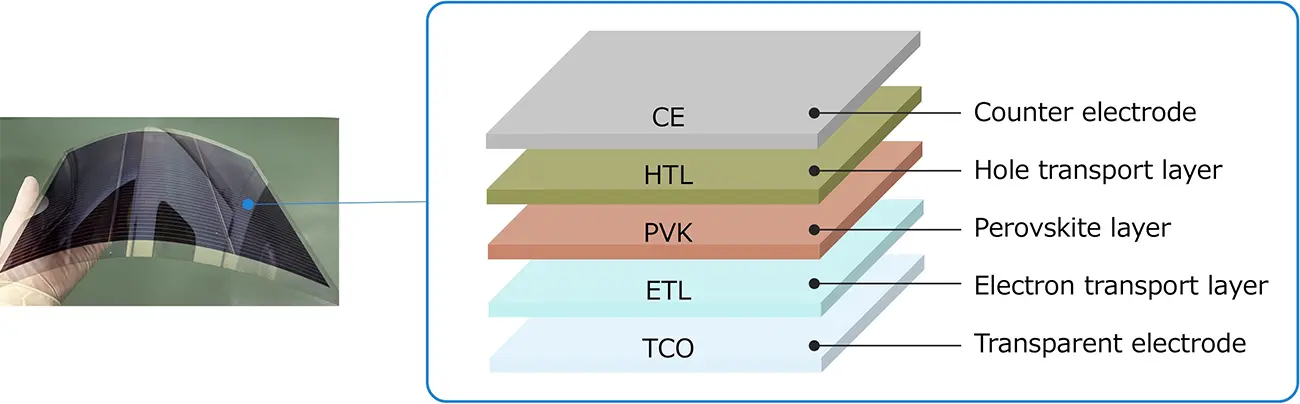
Layer structure of a perovskite solar cell
In a typical production process, the electron transport, perovskite, and hole transport layers are coated by spin-coating or die-coating, with the unnecessary coating film removed through laser processing for each layer. In addition, vacuum deposition is used to deposit the counter electrode.
Such production methods require expensive laser processing machines and vacuum deposition equipment, and each process is also time consuming. This makes it difficult to reduce costs and improve productivity.
To address these issues, Ricoh utilizes inkjet technology—one of its strengths—to pattern-print all functional layers, eliminating the need for laser processing and vacuum-based deposition processes. Furthermore, by leveraging transport technologies developed through commercial printing and performing high-speed printing while continuously conveying roll-shaped substrates, Ricoh achieves both high productivity and low-cost production.
In addition, with inkjet printing, all functional layers can be stacked at any location through high-precision patterning, allowing for the addition of design features and size customization.
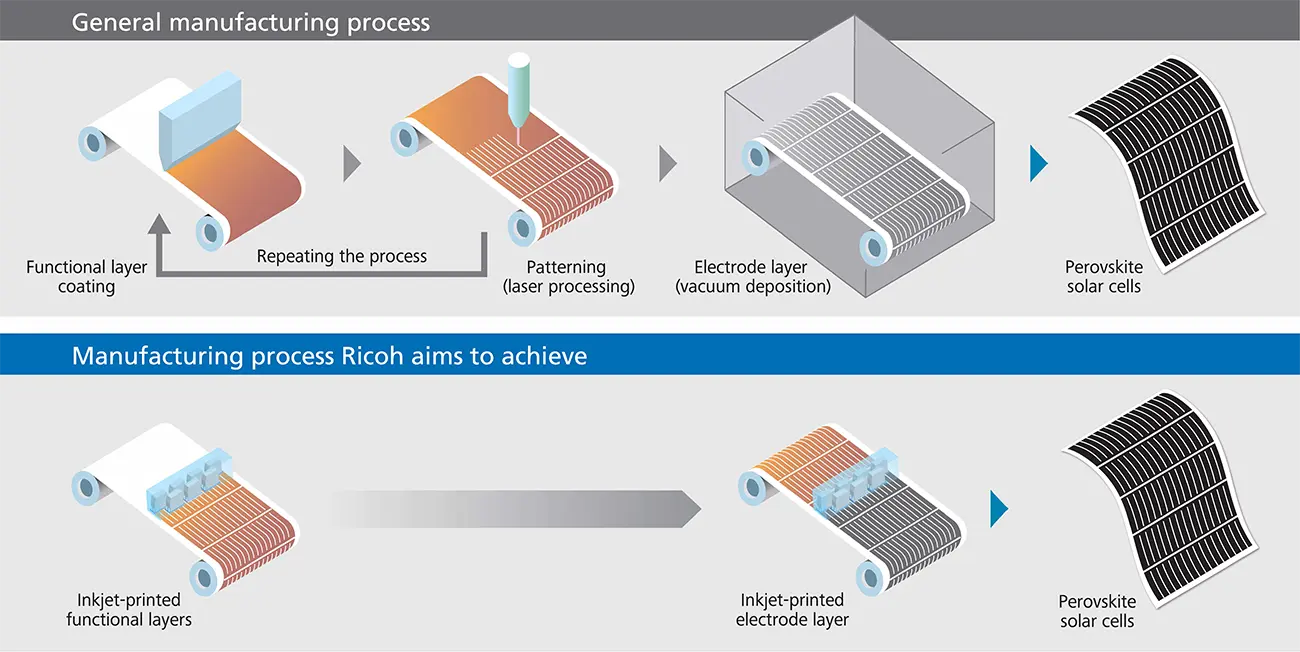
Comparing the general manufacturing process and the manufacturing process Ricoh aims to achieve
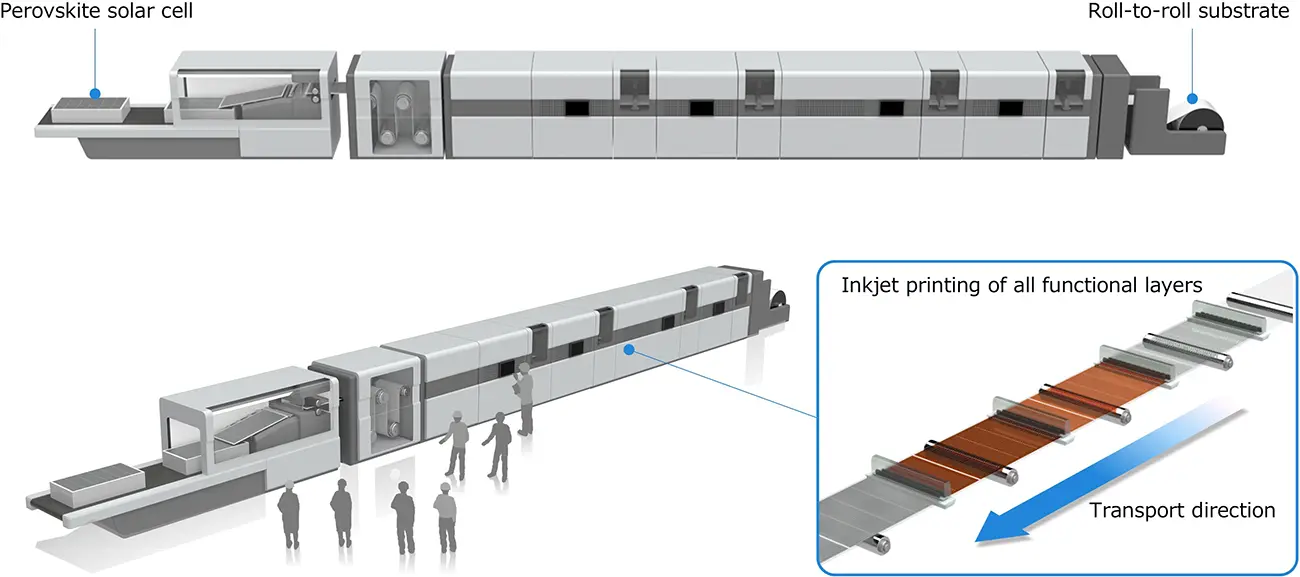
Image of an inkjet-printed perovskite solar cell manufacturing system
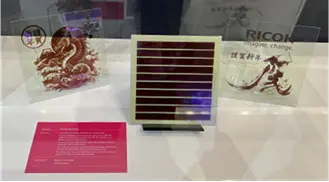
Example of patterning printing
Ricoh's vision
Ricoh is utilizing its three key technologies—inkjet printhead technology, ink supply technology, and printing system technology—that the company has cultivated over many years and is aiming to apply and expand these technologies to create new value with a “digital transformation in manufacturing” that changes the conventional wisdom.
Our method of manufacturing perovskite solar cells is one initiative that utilizes “Functional Material Jetting” which digitally print functional materials.
The realization of high productivity and low-cost production of film-type perovskite solar cells through inkjet printing is expected to contribute to the rapid adoption of perovskite solar cells. Ricoh will contribute to the realization of a sustainable society through a wide range of applications. This includes energy generation on wall surfaces and on roofs with low load-bearing capacity, both of which were previously difficult to equip with conventional silicon solar cells, as well as supplying power to various sensing devices found in an IoT-oriented society.
