Global
Initiatives for end of life products
Reuse and recycling program and network
・Reuse and recycling program
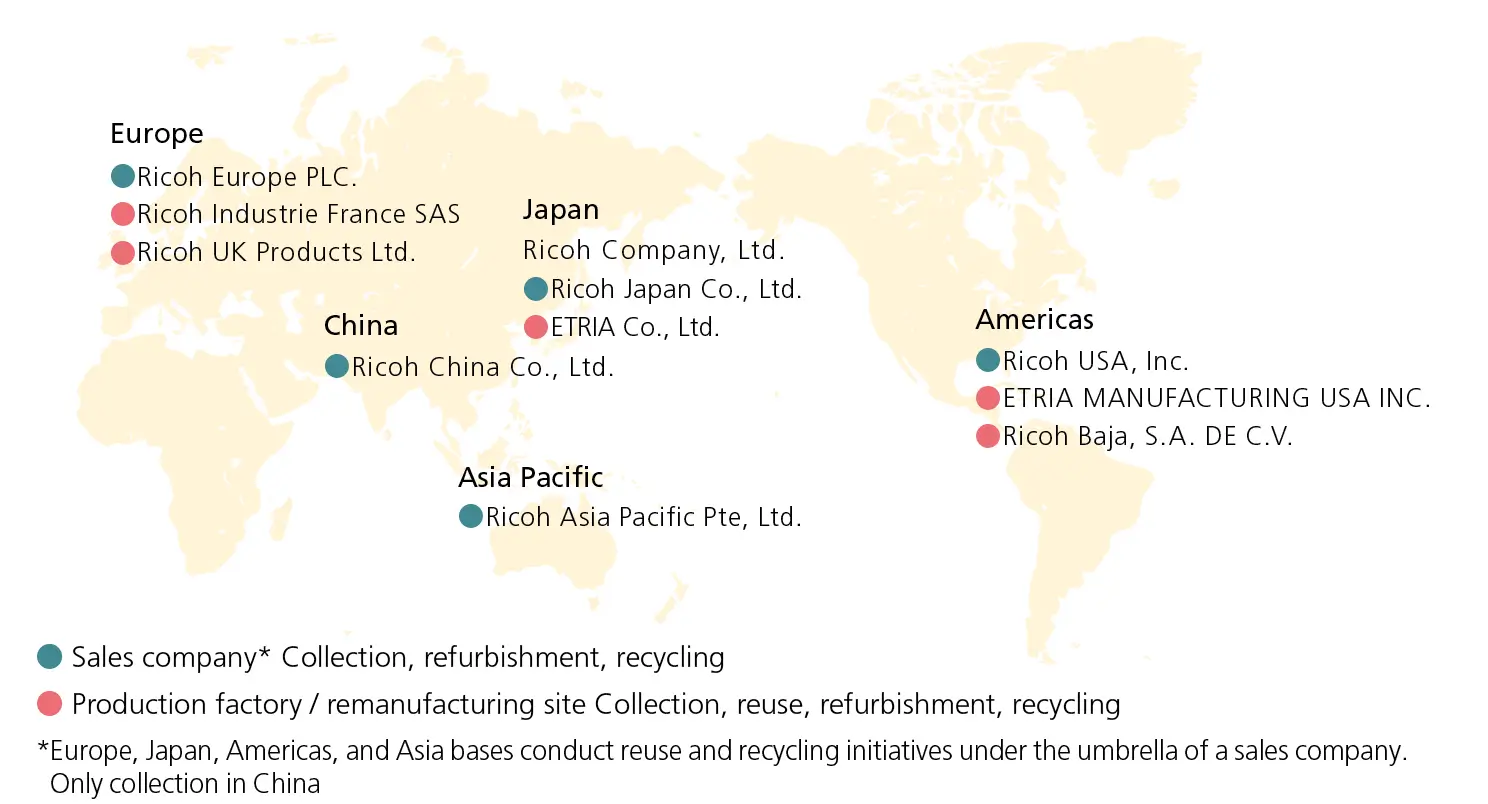
We have practiced resource conservation and recycling as one of the pillars of its environmental conservation activities since the early 1990s and has been developing global reuse and recycling initiatives for MFPs, printers, supplies, and consumable parts collected from customers by region and by product. In treating end-of-life products, the Ricoh Group offers electrical and electronic waste programs in accordance with the waste-related laws and regulations of each country (such as the European WEEE Directive) and strives to recycle them within each country. Furthermore, in accordance with the Basel Ban Amendment to the Basel Convention, the Ricoh Group bans the export of electrical and electronic waste from OECD member countries to non-OECD member countries for disposal and recovery, and confirms that no such exports have taken place. We will continue to maintain compliance with the Basel Ban Amendment to the Basel Convention.
We have established a collection system for End of Life products to ensure effective use of resources in Japan. We also use the know-how we have built up in Japan in regions with different business models, to collection more than 300,000 units/year of our End of Life products worldwide, and to sell approximately 50,000 units/year of these as reused or remanufactured products.
In addition, since 2010 we have been reusing functional parts included in periodic replacement units of imaging equipment.
Regional program
The Ricoh Group has a programme for e-waste that complies with the laws and regulations of each country.
・Japan
In Japan, we have
 end-of-life product and cartridge collection program ( Japanese )
・North Americas
In the US, we have implemented a recycling system for products and consumables. In some of the states, by
utilizing
the MRM System, a state’s program, or
contracted vendors, customers can bring products to designated locations for recycling. Additionally, Desktop
MFPs and printers and used consumables can be conveniently shipped using UPS labels prepaid by Ricoh for proper
recycling. Larger Floor standing MFPs and printers can also be recycled based upon a shared responsibility
process. For more details, please visit
Ricoh USA website.
In Canada, Ricoh
Canada operates a recycling program for Ricoh products available for sale as well as US.
Ricoh Canada website
・EMEA
In Europe, we have
 Resource Smart Return Program
・Asia Pacific
In Singapore, small printers are eligible for the Singapore Government's collection program
ALBA
In China, parts and consumables can be brought in by customers* themselves, using the communication app WeChat to obtain contact information for collection points (*conditions apply for service use). Customers can also return them by post (free of charge).
Programs by product
・Japan:
end-of-life product and cartridge collection
program
・US: Product Stewardship and Recycling/Take Back Program
・Europe:Resource Return
Program
・Reuse and recycling network
We deploy takeback programs, reuse, and recycling efforts through our own facilities in Europe, Japan, Americas,
Asia, and China business regions. Each Group company maintains standards for selecting trustworthy industrial waste
contractors.
These standards include such internationally recognized endorsements as ISO 14001, ISO 9001, R2, and
e-Stewards.
Collection of end-of life products・reuse and recycling
・Japan:
Reuse and recycling program in Japan (Japanese)
/
Audit of Industrial waste disposal company in Japan
・Europe:
GreenLine™
Takeback for supply and parts
・Japan
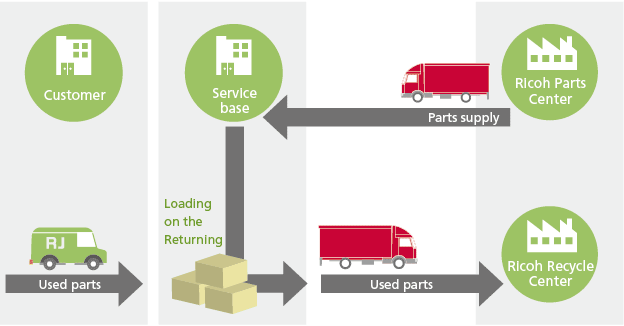
We have introduced a collection and recycling system for replaced
parts that occur
during maintenance services. This system does not dispatch vehicles for parts collection, but loads parts collected
from service bases all over Japan on the return line after parts delivery operated by SBS Ricoh Logistics and
transports them to the recycling base operated by Ricoh.
・Europe
Since 2012, Ricoh (in Europe) has added and strengthened a
new collection
scheme to increase collection of used supplies. We are now working with 17 collection companies in 10 countries
across Europe, and plan to expand this network further.
Takeback by industry Network
・Japan
Ricoh participates in the recovered equipment exchange system run by the Japan Business Machine and Information
System Industries Association (JBMIA).
Through this initiative, equipment turned in by manufacturers of copiers, MFPs and digital printers, including
Ricoh, are collected at shared collection centers and returned to manufacturers, thus promoting the reuse and
recycling of products in the industry overall.
There are 35 collection sites and nine exchange centers for collected machines from Hokkaido to Okinawa,
covering all of Japan.
JBMIA initiatives (Collection system) (Japanese)
JBMIA initiatives (Sharing recycling facilities) (Japanese)
・Europe
In France, 17 office equipment manufacturers including Ricoh
France jointly
invested to establish CONIBI and contracted recovery operations to this joint company. CONIBI has created its
own free collection system and promotes the recycling of toner cartridges and consumables.
Recyclage toner en entreprise
Reuse and recycling businesses
・Key commercialization initiatives
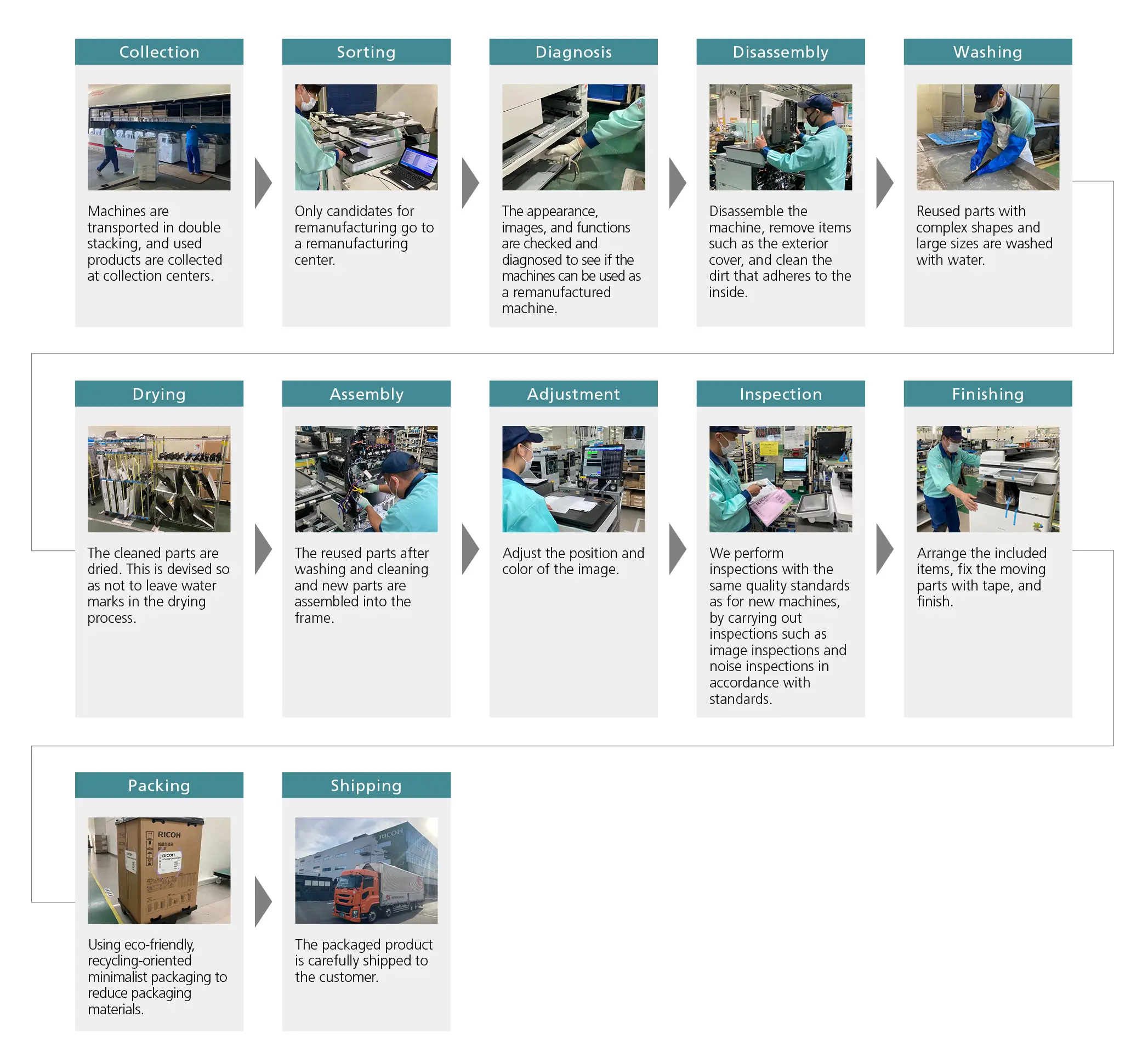
We promote the reuse and recycling of end-of-life products, supplies, and parts collected from customers at our
sites in Europe, Japan, the Americas, Asia, and China. Efficient collection is needed to recycle products, and
we have
established 20 collection sites throughout Japan ( As of February 2025). We have concentrated our recycling
efforts in one location, ETRIA Gotemba Plant, to streamline and improve efficiency. Of the end-of-life products
that are collected, we remove necessary components from non-reusable products, and utilize them as service
parts, replacement parts for reused devices, and parts for newly manufactured products. A mechanism is in place
to disassemble
and separate nonreusable parts by material as much as possible, and send them for material recycling.
In
order to optimize QCD* in the reuse and recycling business, We have established eight types of technologies:
“evaluation technology”, “diagnosis technology”, “disassembly technology”, “cleaning technology”, “washing
technology”, “restoration technology”, “erasure technology”, and “recycling technology”. Technologies that are
especially important for generating profit are those that determine the recyclability of end-of-life products
from an evaluation of the remaining lifetime in their components, and those that diagnose the condition of
end-of-life products selected for reuse.
We have made it possible to streamline recycling through the establishment of these technologies. Moreover, we have expanded to overseas recycling sites and used our Japanese know-how and technologies to make effective use of end-of-life products on a global scale.
* QCD: Quality, Cost, Delivery abbreviation
・Provision of reused products
Provision of remanufactured products
Since 1997, when we launched its first remanufactured products, we have been selling remanufactured products
while responding to the needs of markets in each region of the world. We have multiple types of remanufactured
products to meet the needs of our customers and the market.
- High quality remanufactured products with as-new warranties
- Refurbished products with replaced consumable parts and inspection
- Cleaned and Checked refurbished machines
As high-quality remanufactured machines guaranteed to be as good as new, we sell them
in Japan as RC machines (reconditioning machines), and in
the Americas・
Europeand Asia as the GreenLine series. In
February 2022, the Ricoh Group’ s GreenLine series 9 models (the Americas) became the first in the world to
acquire certification in the “remanufactured imaging equipment” category of the International Energy Star
Program Ver. 3.1.
In addition, remanufactured products require quality assurance specific to remanufacturing, such as data security. For example, when reusing hard disk drives, we fully erase all data through traceability management.
In January 2025, we launched the A3 color remanufactured multifunction printers RICOH IM C4500F CE / C3000F CE. By utilizing technologies that enable efficient sorting, remanufacturing, and inspection of reused parts with AGVs and robots, we have achieved an average parts reuse rate of 86%. In addition, the overall lifecycle environmental impact is reduced by approximately 59% compared with newly manufactured products. Furthermore, for the first time in a remanufactured product, the multifunction printer supports RICOH Always Current Technology, a mechanism that allows new functions to be added to devices via the network through software version upgrades.
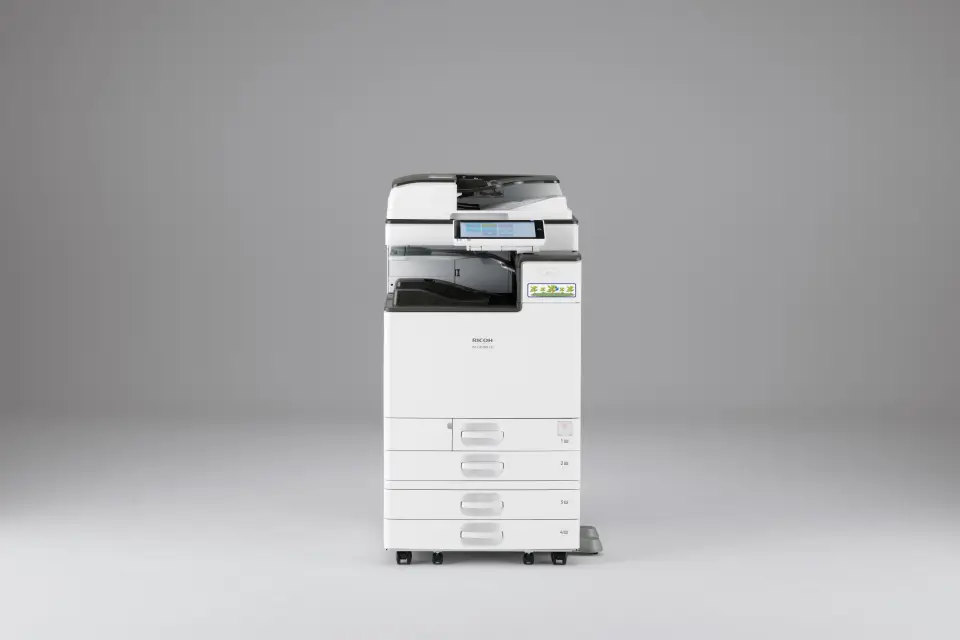
Provision of reused supplies
We are actively involved in remanufactured toner cartridges, toner containers, and other supply products. Collecting used products is essential for reused product supply. Demand for reused products is increasing in areas such as European public procurement, and since 2012, Ricoh Europe has added a new collection scheme to increase the collection of used supply products. We have partnered with 17 collection companies in ten countries throughout Europe, and we plan to expand this network further. In France, 17 office equipment manufacturers, including Ricoh France S.A.S, jointly established CONIBI S.A.S to outsource collection operations. CONIBI S.A.S has formed its own free collection system to promote the reuse and recycling of supply products. Ricoh US also offers a program to encourage the return of used supplies. In order to facilitate customer returns of supply products, by including a prepaid delivery label and reusing the box of a purchased product, not only does this save time and money, but it also contributes to resource conservation.
Through these efforts, we are expanding the collection of supply products and promoting the provision of reused supplies.
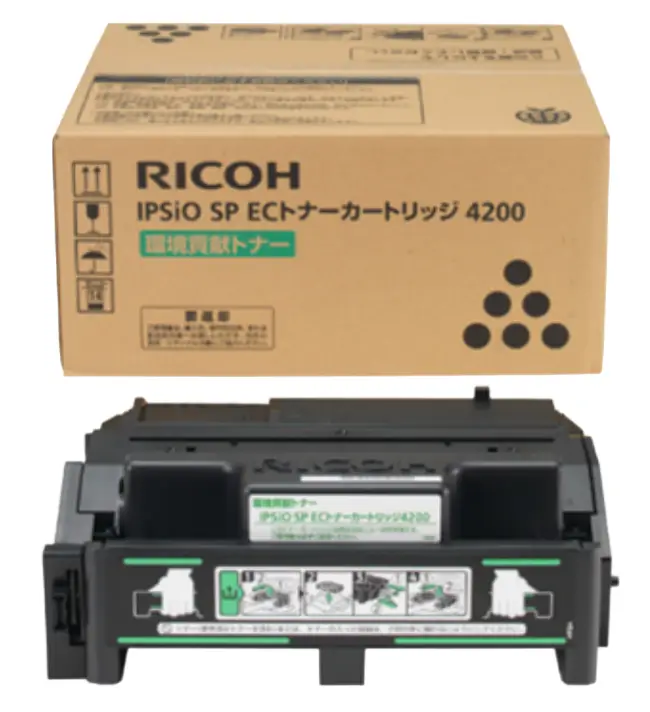
Provision of reused toner
containers
For the toner containers of “RICOH IM C6010/C5510/ C4510/ C3510/C3010/C2510/C2010”, we are remanufacturing them
in Europe and Japan, including toner containers of predecessor models. In most cases, toner containers that did
not have expensive functional parts could not be refurbished due to economic reasons and have been subjected to
energy recovery processing. In this series, we have succeeded in reducing costs by optimizing the collection
method and remanufacturing technology. By remanufacturing toner containers, we plan to reduce the use of new
resources by approximately 190 t / year and CO2 emissions by approximately 1,200 t of CO2 / year starting in
2024. (estimates of both categories for Japan.)
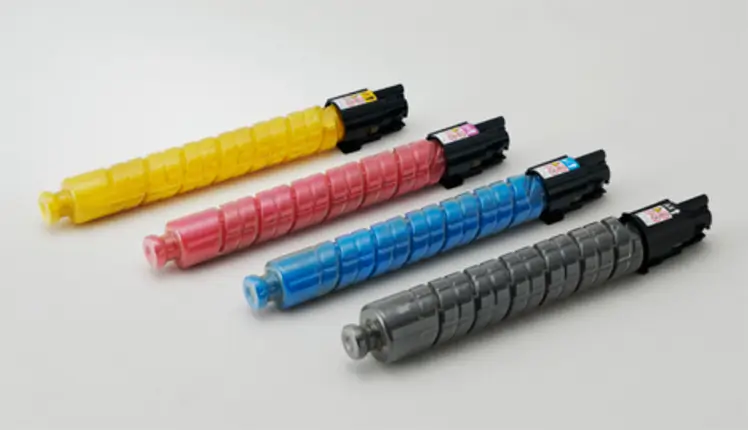
Toner bottles
Toner containers for RICOH IM C8000/C6500 and RICOH Pro C5310S/C5300S are remanufactured without disassembly. We have launched a global initiative to remanufacture color toner containers, in which we collect some of the used toner containers returned by customers, clean them, fill them with new toner, and deliver them to customers again. In order to realize toner container remanufacturing, we have developed a technology for diagnosing the life of specific parts and a technology for cleaning the inside of the toner container without disassembling it. The annual reduction of new resources by remanufacturing toner containers is about 36 t / year, and CO2 reduction is about 210 t of CO2 / year.
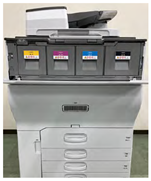
RICOH IM C6500 Tonner bottles(front door open)
Waste management programs
・Waste audits to identify opportunities for improving waste performance
As part of the Ricoh Group’s efforts to reduce environmental impact and realize a circular economy, the company conducts regular waste audits. These audits aim to identify and analyze the types and quantities of waste generated through business operations, thereby pinpointing areas with high waste generation. The findings are used to reduce waste volume, improve recycling rates, enhance the quality of recycling methods, and contribute to better energy performance.
The audits involve reviewing waste management records, conducting on-site inspections, and interviewing relevant departments. These activities support the promotion of resource recovery, proper waste treatment, and improved energy efficiency.
Ricoh will continue to conduct regular audits and pursue continuous improvement to minimize environmental impact and promote the efficient use of resources.
・Action plans to reduce waste generation
We identify business units with high levels of waste generation and prioritizes initiatives aimed at reducing waste in those areas.
The selection of these priority units is based on the results of regularly conducted waste performance assessments and audits.
In addition, the designated priority units and the ESG Promotion Division hold regular progress review meetings and work collaboratively to suppress waste generation and promote resource recovery.
・Quantified targets to minimize waste
We establish specific and measurable quantitative targets for waste management with the aim of continuously improving performance.
For fiscal year 2025, the company has set a target to keep total waste emissions below the previous year's actual performance, with the target volume set at 53,835 tons.
・Investment in innovation or R&D to minimize waste
We actively allocate investments and human resources to research and development (R&D) and innovation activities to minimize waste generated through its business operations.
The Company is engaged in the development of technologies such as those contributing to yield improvement in production processes, those enabling reuse of by-products, and those for the closed-loop recycling of solvents. These efforts contribute to reducing waste and enhancing recycling technologies.
Through these initiatives, Ricoh aims to mitigate environmental impact, promote the circular use of resources, and contribute to the realization of a more sustainable society.
Example: Reuse of resources through closed solvent reusing in the PxP toner (polymerized toner) production process
Ricoh’s Numazu Plant and the Tohoku Plant of Ricoh industry conduct closed recycling of solvents used in the production of PxP toner. Solvents used in part of the production process have been material recycled by subcontractors, but with the aim of recycling and reusing this solvent in our own processes, we have been working on improving material design of toner and production technology. It was difficult to reproduce conventional mixed solvents containing multiple chemicals, but as a result of research, we succeeded in developing production technology using a single solvent instead of mixed solvents. Through this, except for the cleaning solvent generated when switching products, it is possible to reuse the solvent used in production. This not only makes it possible to reduce waste solvents, but we were also able to slash new solvent inputs by about 90%, and we were also able to achieve significant costs reductions. Furthermore, by establishing a process for resolvating waste solvents that had been outsourced, we are now able to cover most of the solvents used in normal production with reused solvents.
・Integration of recycling programs to reduce the waste sent to landfill/Waste diversion from landfill is certified by an independent accredited body
We regularly evaluate the recycling performance of waste generated at each business site with the aim of reducing landfill disposal and promoting resource recovery.
Recycling rate targets are set for each site based on internal standards, taking into account the nature of their operations.
The achievement status of these targets is reviewed periodically, and in cases where targets are not met, corrective measures are implemented. These include efforts to reduce the generation of non-recyclable waste and reconsideration of waste contractors to avoid landfill or simple incineration.
Through these efforts, Ricoh integrates effective recycling programs across the Company and maximizes material reuse.
We regard reducing environmental impact as a critical responsibility and is committed to achieving “zero landfill” of waste generated through its business activities.
The Ricoh Group’s waste management policy extends beyond simple recycling to encompass waste diversion strategies, including reduction, reuse, composting, and utilization as renewable energy. The company’s guiding principle is to prioritize low-impact reuse and recycling practices while minimizing energy recovery through incineration.
Furthermore, Ricoh proactively addresses waste reduction at the source through design-stage prevention and operational process improvements.
To ensure data transparency and reliability, Ricoh obtains independent third-party verification of its waste data.
Third-Party Verification Results
For fiscal year 2024, the diversion rate was 99.7%.
Diversion Rate (%) = (Amount Diverted ÷ (Amount Diverted + Landfilled Amount)) × 100
Audit of industrial waste disposal company
・Using the system to check the vendor
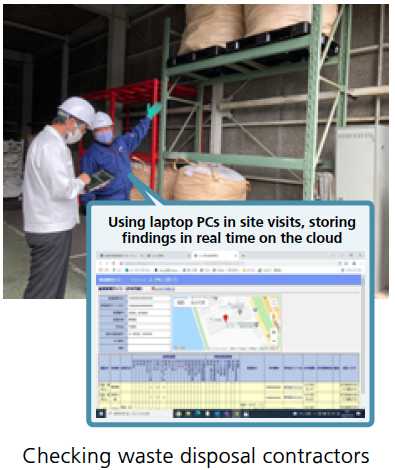
From 2006, we implemented a system to audit waste contractor disposals and operations to fulfill our responsibilities as a waste producer. The annual audit encompasses waste management perspectives and everything from fire and disaster prevention to health and safety, workplace environments, recycling situations, in addition to perspectives related to waste management. We use laptop PCs in site visits, storing findings in real time on the cloud. Checks require wide-ranging expertise, so we set up a team of experienced auditors at Ricoh global headquarters. The system centrally manages audit findings and basic contractor information, which the team can access as needed. The system also manages expiration dates of contractor waste disposal permits. It emails relevant contractor officials before those dates to remind them to stay current.
Businesses contributing to resource conservation
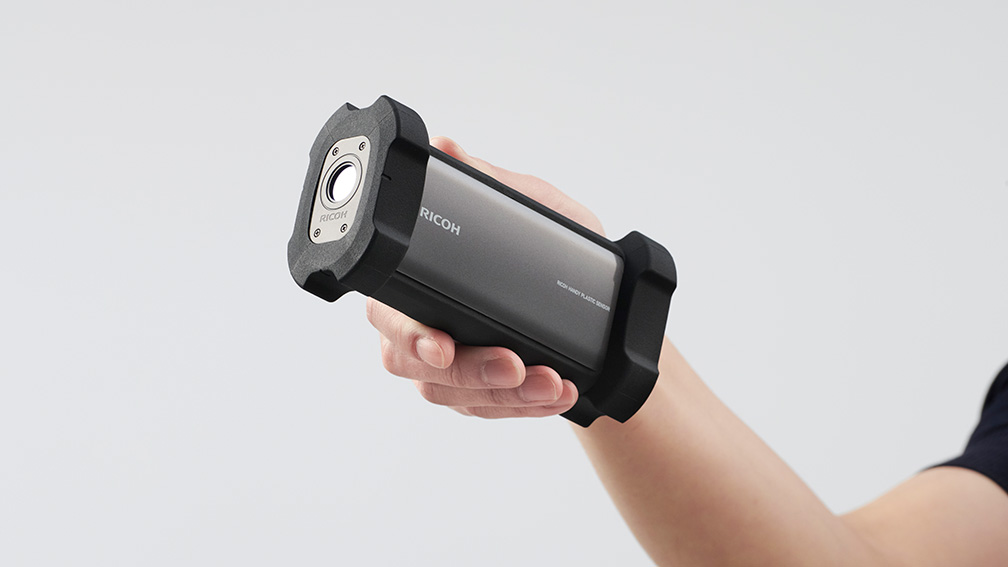
・Portable plastic identification sensor
In March 2023, we launched the RICOH HANDY PLASTIC SENSOR B150, a compact and
lightweight portable sensor that can easily identify plastic materials. The sensor irradiates the
target object with near-infrared rays and measures the spectrum of reflected light to identify the plastic. It
is portable and can also work with smartphones to distinguish 13 types of plastic*. Sorting is essential to
recycle and circulate plastics. By using this sensor, plastic materials can be identified without specialized
knowledge, making sorting easier. It also helps to promote efficient recycling of resources by identifying
offcuts and waste materials from manufacturing plants that would otherwise be discarded without knowing their
composition. In addition to its use by businesses generating plastic waste and recycling companies handling
industrial waste, this product is also used in educational settings to provide hands-on experience in
addressing social issues related to plastics. Initiative participation and advocacy activities Portable
plastic identification sensor RICOH HANDY PLASTIC SENSOR B150 Note: Received the 2022 Good Design Award
(sponsored by the Japan Institute of Design Promotion) and selected as one of the Good Design Best 100.
*As of March 2025