Global
Initiatives based on the Comet Circle™
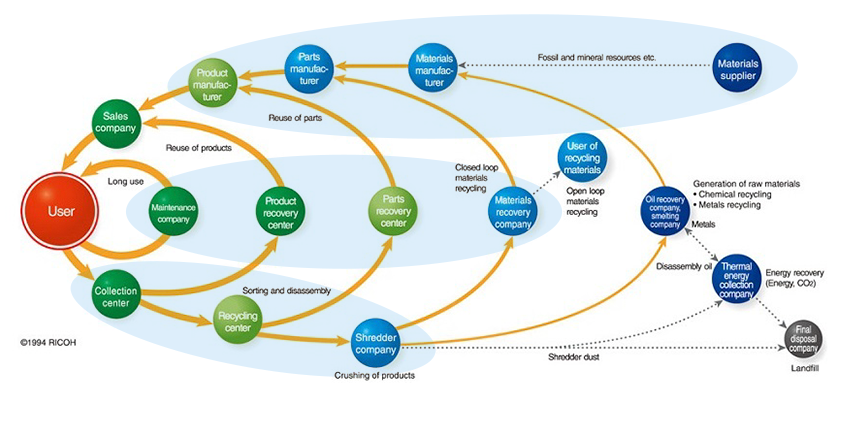
The Comet Circle expresses the greater picture of our environmental impact reduction scheme, which includes the scope of the Ricoh Group as a manufacturer and sales company, as well as the entire lifecycle of our products, such as upstream and downstream of our business activities. Being well aware that product manufacturers like Ricoh, because of our involvement in the early phases of a product’s lifecycle, can make the greatest contribution to reducing environmental impact, we engage in all business taking into account the Comet Circle.
Product design considering 3R (Reduce, Reuse, Recycle) and long-term use
・Design for environment
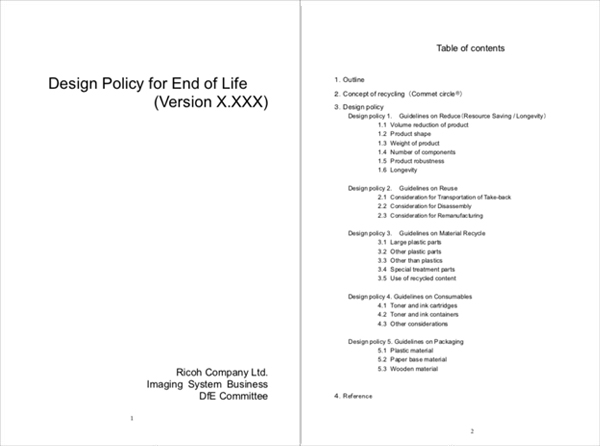
Based on the Comet Circle™ concept, we have formulated and promoted the“ Recycling Design Policy” (current Design Policy for End of Life) . For example, we have established various kinds of technological developments and know-how, such as strength design that assumes reuse, the improvement of dismantling and sortability, and the extension of service life of replacement parts and key parts.
We review our Environmentally Friendly Design Policy from time to time, and make repeated revisions in line with
social trends, markets, and internal activities. Designers conduct a self-assessment of environmentally friendly
design, and consideration of 3R is established as one of the design procedures.
Examples of environmentally
friendly design are introduced below.
1)Use of compatible labels
Compatible labels are labels that maintain the purity and physical properties of recycled plastic even when dissolved and reused while attached to components. The labels have been used for multifunctional printers (MFPs) since 1994. The use of compatible labels has improved work efficiency in the copier recycling process.
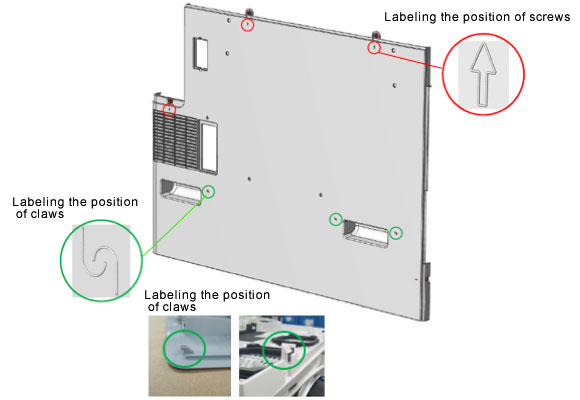
2)Labeling the position of hidden screws and claws
Hidden screws and claws on the exterior cover impede reuse and recycling due to deterioration of disassembly and damage to parts. In 2015, we included in the design policy to indicate the positions of hidden screws and hidden claws on the exterior cover with the aim of improving dismantling work efficiency.