
 Global
News Release Ricoh and ETRIA launch “Circular New,” a manufacturing concept, turning resource circulation into competitive advantage
- Reduces newly sourced material use from about 76% to as low as 21% with product carbon footprint expected to drop by up to 25%
- Delivers latest-generation models with consistent quality, functionality and warranty, while utilizing components recovered from the market
- Strengthens supply chain resilience and manufacturing competitiveness through localized production in Japan and Europe
TOKYO, October 6, 2026 – Ricoh Company, Ltd. and ETRIA CO., LTD. today announced “Circular New,” a manufacturing concept that transforms products already used in the market into assets for future production, turning resource circulation into new product value and manufacturing competitiveness. As the first application, the concept will be introduced to Ricoh’s A3 monochrome multifunction printers (MFPs), with localized production and launch scheduled in Japan and Europe in the first half of 2027.
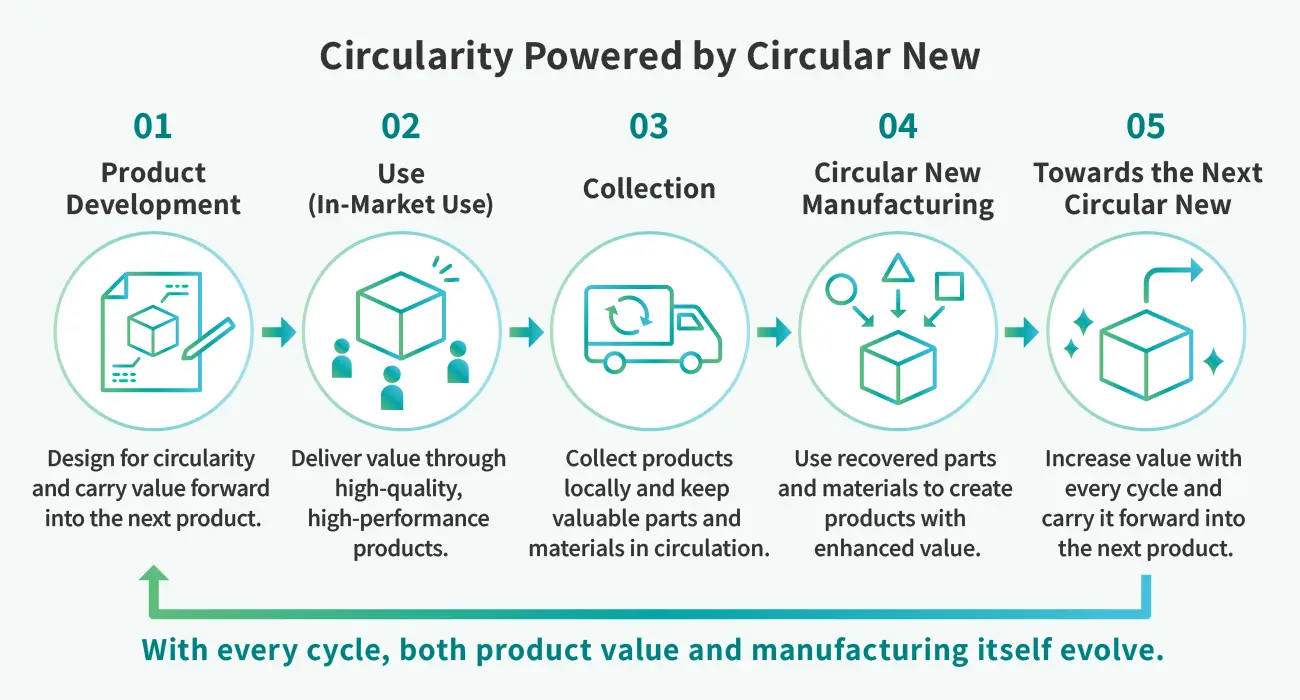
Compared with conventional centralized production at major manufacturing sites in Asia, localized circular production close to consumption markets is designed to reduce the proportion of newly sourced materials used from approximately 76% to as low as approximately 21%.1 Customers will receive the same latest-generation models, with consistent quality, functionality and warranty, regardless of the production method.
Circular New integrates product planning, design, manufacturing, use, collection and reuse into a single continuous loop, utilizing products already in the market as assets to manufacture new products with added value. In addition to conventional centralized production, Ricoh and ETRIA will establish localized circular production in Japan and France to create a regional loop of resource and component reuse, further expanding circularity. Localized production can reduce the product carbon footprint by up to 25%2 compared with centralized manufacturing of the same RICOH IM 6010 model at designated Asian production sites. This reduction is achieved by lowering the use of newly sourced materials and shortening transportation distances, while establishing a resilient supply framework to ensure reliable product delivery amid geopolitical risks, logistics disruptions and resource price volatility. Centrally manufactured and locally produced products will be offered within the same product lineup, delivering consistent product value regardless of manufacturing method or location.
Ricoh and ETRIA have long worked together to reduce newly sourced material use by incorporating recycled materials, such as recycled plastics and steel. Looking toward future circularity, ETRIA integrates design principles from the planning and development stages, including sharing frames and components across generations and models, extending component lifespans and designing structures for simple disassembly and replacement. Building on this design foundation, Circular New combines digital insights into product and component conditions with advanced sorting and quality assurance technologies. This allows Ricoh and ETRIA to go beyond using recycled materials and instead recover and reuse resources and components from existing products directly in the latest-generation models.
With Circular New, Ricoh and ETRIA aim to establish Evolving Circularity—moving beyond reducing environmental impact to continuously channel recovered resources and components into next-generation product value while advancing manufacturing itself.
In its Mid-Term Management Strategy ’26, announced in March 2026, Ricoh set a target of achieving a 30% engine market share for ETRIA by fiscal 2030. Circular New is one of the initiatives supporting this growth strategy, strengthening ETRIA’s manufacturing competitiveness through circular product design and localized production.
Katsunori Nakata, executive corporate officer and president of RICOH Digital Products Unit, Ricoh Company, Ltd., and CEO of ETRIA, said, “Circular New directly challenges the assumption that manufactured products must follow a linear lifecycle. Guided by our principle of aligning ESG with business growth, the Ricoh Group aims to reduce newly sourced material use to 60% by 2030 and 12% by 2050. Through this localized circular production model, we are committed to demonstrating that resource circulation can drive both customer value and manufacturing competitiveness.”
Leading this innovation in Europe, Michael Vavakis, chief transformation, ESG and people officer at Ricoh Europe, said, “The future belongs to organizations that create more value with fewer wasteful resources. Circular New is a powerful example of how innovation can transform sustainability from an environmental ambition into a source of long-term value. By reducing the use of newly sourced materials from approximately 76% to as low as 21%, while strengthening supply resilience and preserving product quality, we believe circularity can deliver both business growth and reduced environmental impact.
At the heart of this transformation are our people, whose expertise, creativity and commitment are enabling us to reimagine manufacturing for a circular economy. This initiative reflects our commitment to building a manufacturing model fit for the future that supports sustainable growth and strengthens regional resilience.”
-
*1By weight, among newly manufactured A3 laser multifunction printers (MFPs). The newly sourced material usage rate varies depending on the utilization of recovered components.
-
*2Calculated based on life-cycle greenhouse gas emissions (CO2 equivalent). The product carbon footprint reduction rate varies depending on the utilization of recovered components and transportation distances.
ENDS
Additional Information
Background
In recent years, growing climate concerns, resource constraints, geopolitical uncertainties and supply chain disruptions have driven the manufacturing sector to adopt production models that reduce environmental impact while ensuring a stable product supply. Guided by its policy of aligning ESG with business growth, the Ricoh Group has set targets to reduce the ratio of newly sourced materials used in its products to 60% by 2030 and 12% by 2050.
Through Circular New, the Ricoh Group aims to accelerate this linear-to-circular transformation (“LC transformation”), moving away from the conventional model of mass production and mass consumption toward a circular economy. By combining circular product design with localized production close to consumption markets, Ricoh aims to reduce environmental impact while ensuring stable product supply and enhancing manufacturing competitiveness, building an engineering and production foundation that continues to be the choice of brand owners and OEM partners.
Overview of the initiative
1. Product design based on circularity
Under Circular New, products are designed not to reach the end of their lifecycle after shipment, but to serve as assets for future products. By sharing frames and components across generations and models, extending component lifespans and simplifying disassembly, Ricoh can utilize resources and components recovered from the market to manufacture new products. Unlike conventional remanufactured machines3 or refurbished machines,4 which are restored to near-original condition for resale, Circular New incorporates recovered parts and materials into newly manufactured products within Ricoh's current lineup.
As the first model adopting this concept, Ricoh's A3 monochrome MFP series, RICOH IM 6010/4510/3510/2510, will be produced and supplied in Japan and Europe beginning in the first half of 2027 through circular production, alongside existing centrally produced machines. Ricoh will deliver them as the latest-generation products with globally consistent quality, functionality and warranty. Localized circular production will cut newly sourced material use for these models from about 76% to as low as 21%.
-
*3Ricoh uses the following definitions: A machine manufactured through an industrial process based on machine that has been used at least once on the market, has undergone at least one change that influences the safety, performance, purpose or type of the product, and is then resupplied to the market after remanufacturing.
-
*4Ricoh uses the following definitions: A machine that has been placed on the market and used at least once and has been maintained or repaired to restore its original functional or aesthetic condition or restored to a predetermined form or functionality.
2. “Localized Circular Production” that circulates resources locally
Under Circular New, alongside centralized production in Thailand and China, Ricoh will establish localized circular production to recover and cycle resources into new products close to consumption markets. Through regional circulation, the RICOH IM 6010 produced under localized circular production is designed to reduce its product carbon footprint (CFP) by up to 25% compared with the same model manufactured under centralized production at Asian production sites.
As an initial step, newly manufactured products will be produced through localized circular production at ETRIA Manufacturing Japan's Gotemba Site in Japan and ETRIA MANUFACTURING FRANCE S.A. in France. By establishing a regional cycle of “collection → resource and component utilization → production → use → recollection,” the initiative reduces environmental impact from transportation while strengthening resilience against supply chain fragmentation and logistics disruptions.
Future outlook
Ricoh will promote circular ecosystems involving customers, while ETRIA advances circular product design and expands localized circular production infrastructure. Starting in Japan and Europe, both companies will expand the application of Circular New while exploring collaboration with brand owners and OEM partners. Through these efforts, Ricoh and ETRIA aim to establish Circular New as a scalable manufacturing approach that drives resource circulation and business growth.

| About ETRIA |
ETRIA is a manufacturing company built on the combined technologies and experiences of Ricoh, Toshiba Tec, and OKI. Focused on the development and production of imaging equipment, such as multifunction devices and printers, the company offers devices that seamlessly connect analog and digital information, elevating the value of information delivered. ETRIA will support customers in overcoming their challenges and continue to serve as their trusted partner dedicated to the advancement of society.
For more details, please visit  https://etria.global/en/.
| About Ricoh |
Ricoh is a global integrator in workplace transformation, operating in approximately 200 countries and regions and headquartered in Tokyo. Supporting customers' value creation, Ricoh offers workplace services and solutions that empower organizations to work smarter through advanced technologies—including AI— together with long-standing expertise rooted in printing. Ricoh also operates commercial and industrial printing businesses and delivers new solutions leveraging inkjet technology. In the financial year ended March 2026, Ricoh Group had worldwide sales of 2,608 billion yen (approx. 16.4 billion USD).
For 90 years since our founding, Ricoh has upheld its mission and vision of empowering individuals to find Fulfillment through Work—and that commitment continues today. By understanding and transforming how people work, we unleash their potential and creativity to realize a sustainable future.
For further information, please visit
###
© 2026 RICOH COMPANY, LTD. All rights reserved. All referenced product names are the trademarks of their respective companies.

PDF Download
News release in PDF format
