
 Global
Ricoh Group Integrated Report 2026 Interview with the CFO

Strengthening Execution and Improving Capital Efficiency to Achieve ROE Above 10%
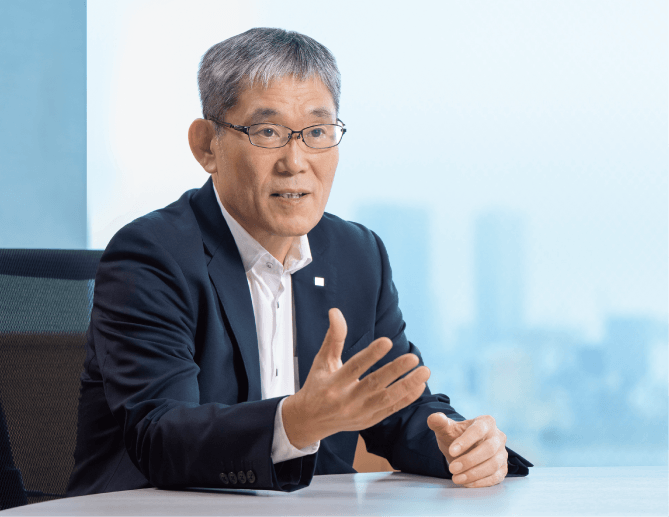
Takashi Kawaguchi
Executive Corporate Officer
Chief Financial Officer
September 8, 2026
Mar 1986
Joined the Company
Consistently engaged in accounting and finance operations since joining the company
Served as CFO of group companies after two long-term assignments in North America
May 2007
CFO of InfoPrint Solutions LLC
Aug 2010
SVP (Senior Vice President) of Ricoh Americas Holdings, Inc.
Oct 2015
General Manager of Planning Department, Global Capital Management Support Center, Corporate Division
Apr 2018
General Manager of Finance Department, Finance and Legal Division and General Manager of CEO Office
Oct 2018
Executive Officer and General Manager of Corporate Management Division of RICOH LEASING COMPANY, LTD.
Apr 2020
Director and Corporate Senior Vice President of RICOH LEASING COMPANY, LTD.
Jun 2021
General Manager of Finance and Accounting Division
Chairperson and President of Ricoh Americas Holdings, Inc.
Apr 2022
Corporate Officer
CFO (Current)
Apr 2023
Executive Corporate Officer (Current)
Jun 2023
Director (Current)
Q1. How would you summarize the business results of the 21st Mid-Term Management Strategy?
In fiscal 2025, consolidated sales increased 3.2% year on year to ¥2,608.3 billion, operating profit rose 42.1% to ¥90.7 billion and profit attributable to owners of the parent increased 21.8% to ¥55.6 billion. ROE improved to 5.1%. Even though profitability has steadily recovered, we did not reach the targets set in the 21st Mid-Term Management Strategy. We take this result seriously, as we were unable to fully meet the expectations of shareholders and investors.
At the start of the 21st Mid-Term Management Strategy, we recognized that continuing with business as usual would not be enough to achieve our targets. This sense of urgency led us to launch the Corporate Value Improvement Project. Through this project, we reduced fixed costs, reviewed our business portfolio, and advanced structural reforms in the Office Printing business. We positioned the Office Services business as a pillar of growth and worked to build up recurring earnings. In the Office Printing business, where the market continues to shrink, we established ETRIA and undertook initiatives such as reviewing our sales and services structure and optimizing our supply chain. As a result, we generated profit improvements worth ¥57.8 billion over the two years from fiscal 2024 to fiscal 2025.
However, despite improvements in our earnings structure, we have not yet reached a level where we can consistently generate returns above the cost of capital, and challenges remain in both the speed and execution of earnings improvement. The business environment is changing rapidly, with factors such as U.S. tariff policy, economic weakness in Europe, and rising tensions in the Middle East creating uncertainty. At the same time, AI is significantly transforming the way people work. In this environment, we must use the data available to us, address issues without delay, translate them into concrete actions, and execute them swiftly.
Q2. What did you place the greatest emphasis on when formulating Mid-Term Strategy ’26?
We placed the greatest emphasis on working backward from where we aspire to be in the future. Starting with a vision for five years ahead, the executive team came together multiple times over the course of one year to thoroughly discuss what should be changed in our businesses, organizations, and earnings structure to realize that vision. Furthermore, we compiled a financial tree linking the expansion of recurring earnings to ROIC, ROE, and PBR, visualizing how each strategy and initiative contributes to financial performance. As a result, this enabled us to formulate a mid-term strategy that is consistent—from the future vision right through to strategy and financial targets.
Q3. Please tell us about your approach to enhancing corporate value.
The financial goal of Mid-Term Strategy ’26 is to achieve an ROE above 10%. We estimate our cost of equity at around 7.5% to 8.0%. By consistently achieving an ROE above this level, we aim to enhance TSR through both share price appreciation and shareholder returns.
To that end, my role is to build a financial foundation and prepare management options that enable us to continue creating value, whatever changes may arise in the operating environment. The target of achieving ROE above 10% was set after careful consideration from that perspective. It is grounded in realistic assumptions, not wishful thinking. We see it as the level we ought to achieve even after factoring in various conceivable scenarios, such as deterioration in the business environment or changes to our business portfolio.
To achieve it, we will simultaneously use three levers: profit growth, enhancement of asset efficiency, and optimization of capital structure.
We will enhance profit growth and cash generation by expanding recurring earnings centered on Workplace Services and improve asset efficiency by driving the transition to an asset-light business structure. At the same time, we will appropriately utilize debt, based on stable cash flow to optimize the cost of capital. By pursuing these three measures simultaneously, we will improve ROE. Among these, expanding recurring earnings is especially important. This is because it not only enhances earnings stability, but also leads to an improvement in capital efficiency.
Our net D/E ratio is currently below 0.3x, and going forward, we will manage it within an appropriate range of up to 0.4x. The purpose is to maintain financial soundness while moving toward a more appropriate capital structure. By keeping financial risk within an appropriate range and making effective use of debt, we aim to reduce WACC, expand the equity spread, improve capital efficiency, and sustainably generate returns that exceed the cost of capital.
Q4. How do you carry out cash allocation?
We execute growth investments while maintaining financial discipline that is mindful of our credit rating. In addition, as we transition to an asset-light business structure, we will optimize asset efficiency, including maintaining an appropriate level of liquidity on hand. We are also continuing to strengthen cash management globally.
The Treasury Department at Headquarters will centrally manage cash across the Group and optimize fund allocation. Through this, we will improve capital efficiency, strengthen financial governance, and further reinforce our financial foundation.
In Mid-Term Strategy ’26, we have allocated approximately ¥350 billion of generated operating cash flow for growth investments, of which about ¥250 billion will be allocated to M&A and other investments. We intend to concentrate our M&A activities on the Workplace Experience and Process Automation domain so as to develop software in-house and generate recurring earnings.
At the meetings of the company-wide Investment Committee, I continuously ask why certain investments are necessary for Ricoh. We execute M&A deals not just to expand sales, but to create synergies and enhance cash generation capabilities and capital efficiency. We conduct rigorous assessments, including PMI considerations, during the acquisition process and make timely decisions to exit businesses when necessary. As for research and development, we plan to continue investing in the inkjet domain and in creating synergies with ETRIA.
Q5. How will you drive growth in recurring earnings?
The Ricoh Group is transforming its business structure from a company centered on printing to one that delivers value primarily through Workplace Services. In Workplace Services, a key growth area, our regional sales and service companies will expand recurring earnings by acting as integrators, leveraging customer touchpoints to broaden and enhance the value we provide. We will accelerate growth and improve profitability by rolling out successful regional practices globally and deploying the solutions of acquired companies such as DocuWare, natif. ai, and Axon Ivy based on insights gained in each region. Furthermore, we will improve profitability by standardizing globally, as much as possible, the products and services we combine and offer.
From a financial perspective, we emphasize linking the growth of recurring earnings to improvement in capital efficiency. We will raise the ROIC of regional sales and service companies from the current 5.3% to 13%, and expand their business scale by 15% by fiscal 2030. Through these efforts, we aim to achieve company-wide ROIC in excess of 7% and ROE above 10%. We plan to increase growth in recurring earnings from 1.8% in fiscal 2025 to 2.5% in fiscal 2026, and further to around 3.0% thereafter. These growth rates also factor in the contraction of recurring earnings in printing. By fiscal 2030, we will increase Workplace Services’ share of recurring earnings from 21% to 37%.
Workplace Services is an asset-light business with a low inventory burden, so we expect to generate stable cash flow from ongoing contracts. A higher services weighting will lead not only to stabilizing earnings, but also to improving working capital efficiency and the cash conversion cycle. The expansion of recurring earnings is important not only to our growth strategies but also to cash generation and improvements in capital efficiency.
Q6. What initiatives are you implementing for cost structure reforms and the transition to an asset-light model?
Cost structure reforms are not something to be completed under the Corporate Value Improvement Project implemented in the 21st Mid-Term Management Strategy. Instead, they are an ongoing effort. As our business portfolio continues to evolve, we will constantly update our structural reforms. Considering inflation and many other uncontrollable external factors, we will implement appropriate pricing for our products and services, but what is more important is that we continuously pursue cost improvements by strengthening our underlying business structure. More specifically, we will focus on advancing four key initiatives.
The first is our Back-Office Operations Transformation, focused primarily on corporate functions. We will enhance operational efficiency through the utilization of DX and AI and optimize the overall organization by reallocating talent and capacity created through those efficiencies to growth areas.
The second is Global SCM Transformation. As we ramp up our business as a workplace integrator, we will strengthen global procurement capabilities and improve “last-mile” efficiency by reforming logistics operations.
The third is Business Portfolio Optimization for both business units and Group companies. Based on market conditions and profitability, we will review not only the businesses but also the structure of Group companies. In some regions, we will transition to an optimal business model, including the utilization of sales partners, rather than focusing on direct sales.
The fourth is Asset Rationalization and Site Optimization. In optimizing our sites, we will review our multiple shared service centers worldwide not only from the perspective of consolidation, but also from the perspective of which functions can be performed most efficiently at which locations. We will rebuild our structures from the viewpoint of overall optimization and establish more productive operations.
By advancing these four initiatives in a holistic manner, we will reduce costs and assets by more than ¥40 billion.
Q7. Can you tell us about your fiscal 2026 earnings forecasts and shareholder return policy?
As a milestone toward our five-year goals, we are targeting fiscal 2026 consolidated sales of ¥2,700 billion, operating profit of ¥95 billion, and profit attributable to owners of the parent of ¥62 billion. Workplace Services will drive growth. The effects of the Corporate Value Improvement Project implemented under the 21st Mid-Term Management Strategy will also continue. Although we anticipate increased costs for semiconductor memory, we believe that most of this can be absorbed through pricing revisions and reforms in SCM and procurement.
We are also taking measures to address risks such as rising material and logistics costs due to the situation in the Middle East and other geopolitical factors.
As for shareholder returns, we are targeting a total return ratio of 50% and are committed to increasing dividends every fiscal year. For fiscal 2026, we plan to pay an annual dividend of ¥44 per share, which is expected to mark the sixth consecutive year of dividend increases. Furthermore, we will carry out share buybacks worth ¥25 billion, acquiring up to 23 million shares, which corresponds to 4% of outstanding shares (excluding treasury stock). As a result, we forecast a total return ratio of around 80%.
Q8. As CFO, what are your most important beliefs?
What I have consistently valued is discussing matters based on facts. This means understanding the actual conditions on the ground and the business structure behind the numbers, and identifying the challenges that lie ahead. In addition, while each department is doing its best from their respective standpoints, I take a broader, company-wide view to determine whether those efforts represent the optimal solution for the entire company and then verify that through data. I refer to this process as “putting things in order.” Through the accumulation of these efforts, I aim to enhance execution and speed and improve the quality of decision-making.
I also value face-to-face talks with employees so that management and frontline employees can stay connected. That is why we hold roundtable meetings with employees. Rather than just me speaking one-sidedly, I stress the importance of employees asking the questions they want answered and openly discussing the challenges they face. And I always make sure to communicate the importance of continuous learning. That can be anything. I believe that the pursuit of continuing to learn is what fosters personal growth. As AI becomes increasingly widespread, there will be more situations where people do not need to read, write, or think for themselves. Precisely because of this environment, I believe it is essential for people to think independently, take action, and continue absorbing knowledge.
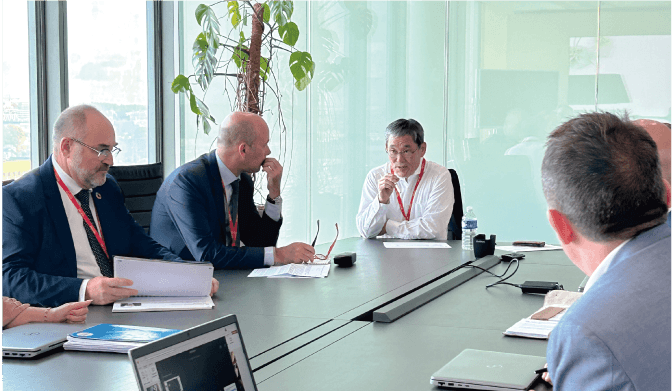
Roundtable meeting at Ricoh France
Q9. How do you view communication with shareholders and investors?
I regard it as an important process for enhancing corporate value. Shareholders and investors critically evaluate not only financial performance but also the validity of our strategies, execution capabilities, and management’s recognition of issues. To earn support from the capital market over the medium-to-long term, it is important to carefully explain the business structure and market environment behind the data and help shareholders and investors understand how the Ricoh Group’s initiatives contribute to enhancing corporate value. At the same time, we honestly communicate not only our strengths but also areas for improvement and future challenges. We aim to share in a transparent manner the issues we recognize and the options available to us, while applying the insights gained through these exchanges to our management.
