
 Global
Ricoh Group Integrated Report 2026 Message to Our Stakeholders

Becoming the Leading Global Integrator of the Customer’s Workplace
— Expanding Recurring Earnings and Driving Asset-Light Growth to Enhance Corporate Value
Akira Oyama
President and CEO
September 8, 2026
Jul 1986
Joined the Company
Engaged in sales for overseas OEMs and domestic sales subsidiary, later involved in PMI of companies acquired in Europe and the U.S.
Apr 2011
President and COO (Chief Operating Officer) of Ricoh Europe Plc
Aug 2012
Group Executive Officer
CEO of Ricoh Europe Plc
Apr 2014
Corporate Senior Vice President
General Manager of Corporate Division
Jun 2015
Director
Jun 2016
Corporate Executive Vice President
Apr 2017
CFO (Chief Financial Officer)
Apr 2021
Executive Corporate Officer
President of Ricoh Digital Services Business Unit
Jun 2021
Director
Apr 2023
Representative Director, President and CEO (Current)
Commitment to Enhancing Corporate Value
Ricoh has entered the phase in which the structural reforms and portfolio transformation we have pursued until now must deliver visible results. Under Mid-Term Strategy ’26, we will accelerate the transformation of our earnings model by expanding recurring earnings, growing asset-light businesses in the Workplace Services domain, and making greater use of globally common components and platforms. Our aim is to become the leading global integrator of the customer’s workplace—combining Ricoh and third-party products, services, software, and advanced technologies to help customers strengthen their competitiveness and create new value.
We take seriously the fact that we did not achieve the financial targets of the 21st Mid-Term Management Strategy. The lessons are clear: we must protect the earnings base of existing businesses while building growth areas faster, and we must execute with greater speed and discipline. By improving earnings stability and capital efficiency, we will place Ricoh firmly on the path to achieving ROE of 10%. We will restore trust through transparent communication, clear accountability, and tangible results.
Reflecting on the 21st Mid-Term Management Strategy
The 21st Mid-Term Management Strategy concluded in fiscal 2025. Against our targets of ¥130.0 billion in operating profit and ROE of 9%, we recorded operating profit of ¥90.7 billion and ROE of 5.1%. Excluding the effects of certain tariff policies and other temporary factors, operating profit was ¥106.2 billion and ROE was approximately 7%. As CEO, I take this outcome very seriously. One key factor was that profitability in the Office Services business did not improve at the pace we had anticipated. The business, positioned as a pillar of our long-term growth, corresponds to today’s Workplace Services domain. During the 21st Mid-Term Management Strategy period, we captured emerging customer needs driven by digitalization and advances in AI and secured many new service contracts. However, in Workplace Services, recurring revenue accumulates over time following the initial implementation phase. Even taking this characteristic into account, we did not convert business growth into profitability quickly enough, and profitability did not improve at the pace we had expected.
In the Office Printing business as well, amid continued market contraction, a decline in MFP market share resulted in lower sales in the highly profitable non-hardware domain. We also fell short in supporting frontline sales organizations and executing initiatives quickly enough to maintain and reinforce our customer base. These experiences have clarified where we need to focus and how we should direct our efforts to strengthen our core businesses. We will apply these lessons to the next stage of Ricoh’s transformation.
At the same time, we understood that long-term growth could not be achieved by maintaining the existing structure. We therefore advanced the Corporate Value Improvement Project to reform our cost structure, shift resources from mature areas to growth areas, and withdraw from businesses in which further investment could not be justified. As part of these efforts, we established ETRIA, a joint venture aimed at strengthening competitiveness in the Office Printing business in light of the contracting market, and worked with partner companies to reinforce our capabilities. Through these actions, we clarified the direction of Ricoh’s structural transformation.
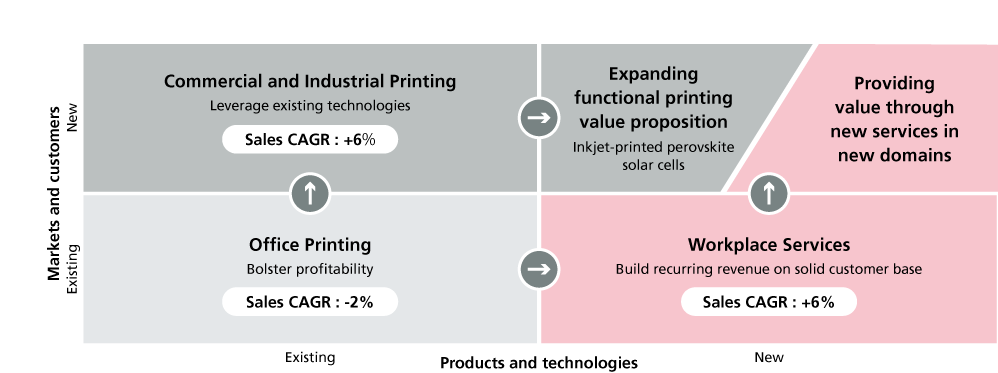
The key lesson is that transformation must be managed from a portfolio-wide perspective. We cannot focus only on new growth areas while allowing the earnings of existing businesses to decline too quickly. Office Printing must continue to support our earnings base. Workplace Services must become the main growth driver. Commercial and Industrial Printing must provide stable earnings while extending our technologies into new domains. Each business has a distinct role, and corporate value will increase when those roles are fulfilled as part of an optimized portfolio. Therefore, we enter Mid-Term Strategy ’26 with a clearer direction and a stronger sense of urgency. The structural reforms have created a foundation, and the recurring earnings base has begun to build. We must now convert that progress into higher profitability and capital efficiency. Above all, we must raise the speed and quality of execution. The direction of our transformation remains valid. What the 21st Mid-Term Management Strategy made clear is that we must accelerate our portfolio transformation and execute with greater speed in the next phase.
Value Creation with Mid-Term Strategy ’26
A Five-Year Rolling Strategy
Mid-Term Strategy ’26, which began in fiscal 2026, marks a change from our traditional three-year fixed plan to a rolling strategy that looks five years ahead and is reviewed annually. This change reflects the speed and uncertainty of the current business environment. Technologies such as generative AI are developing rapidly, customer needs are changing, and assumptions that appear reasonable when a plan was prepared can change materially within its first year. At the same time, managing the Company only through one-year plans would be inadequate. Human capital development, the strengthening of business platforms, portfolio transformation, and growth investment all require a medium- to long-term perspective. By looking five years ahead, we can use backcasting rather than simply extending current activities. We begin with the future position we want to achieve, identify the gap from today, and determine what must be done to close it. This approach allows us to consider measures that may not emerge from incremental planning and to update the path each year as conditions evolve. The rolling approach does not change our commitment to the goals we have set. We will update our assumptions, priorities, and actions each year, but our target of achieving ROE of at least 10% in fiscal 2030 remains firmly in place. Our focus is on achieving each annual target with discipline and building a record of performance that restores the trust of shareholders and other stakeholders.
Balancing Existing Earnings and New Growth
The starting point of Mid-Term Strategy ’26 is to use the Ricoh Group’s management resources more effectively and to clarify the role of each business. The Workplace Services domain* remains the main growth area, but sustainable transformation cannot depend on a single business. We must maintain the competitiveness and earnings of the Office Printing domain, accelerate growth in the Commercial and Industrial Printing domain, and expand into new fields by applying Ricoh’s core technologies. Our portfolio transformation begins with the customer relationships and installed base that Ricoh has built through Office Printing. These customer relationships give us a strong foundation from which to expand the Workplace Services domain. However, the Office Printing domain continues to be an important source of earnings and cash flow. If its profitability declines too rapidly, growth in services will not accumulate fast enough to support the Group as a whole. We will therefore manage the Office Printing domain as a mature but strategically important business, working to stabilize earnings and maintain or expand share. The Commercial and Industrial Printing domain has a different role. It supports stable earnings while also extending Ricoh’s printing and inkjet technologies into new markets. Inkjet technology, for example, can contribute beyond conventional printing. In fields such as perovskite solar cells, the precise jetting of functional materials using inkjet technology may provide greater design flexibility and improve manufacturing productivity. By applying our technological strengths to areas related to energy, the environment, and advanced manufacturing, we can create new sources of growth while helping to resolve social issues.
-
*Beginning in fiscal 2026, the reportable segment was changed from Office Services to the Workplace Services domain. For details, please see page 130 of the Notice of the 126th Ordinary General Meeting of Shareholders.
Creating Value in the Customer’s Workplace
Ricoh will pursue this ambition by combining Ricoh and third-party products, services, software, and advanced technologies—including AI—to provide customers with the workflows and workplace environments they need to strengthen competitiveness and create value. Many competitors can provide integration within a particular country, region, or specialized field. Far fewer can deliver consistent value across countries and regions while combining a broad range of technologies and services. Ricoh’s global customer base, local customer relationships, and ability to provide and support solutions in multiple regions give us a distinctive opportunity. Our approach is not to impose one region’s business model on another. Customer needs, commercial practices, regulations, and market structures differ. A solution developed in Japan cannot simply be transplanted unchanged to North America or Europe. What we can do is identify the components, capabilities, and best practices that can be shared. A solution may contain several elements; some may be globally applicable, while others require local adaptation. By standardizing the elements that can be shared and combining them with local expertise, we can improve both customer value and profitability. This is also important for Global Major Accounts. Multinational customers want employees in different countries to communicate and collaborate within consistent, secure, and productive environments. Ricoh can help design and operate those environments while adapting them to local requirements. Providing a common foundation enables diverse people to work together more effectively and can support the creation of new value. A global presence also allows knowledge to circulate. Practices developed in Europe can inform solutions in Japan or North America, and innovations created in Asia Pacific can be adapted elsewhere. We will strengthen this exchange of knowledge and solutions across the Group. At the same time, we will expand common service portfolios and platforms so that growth is accompanied by higher margins, rather than by complexity and duplicated costs.
Recurring Earnings and Asset-Light Growth
The equity story of Mid-Term Strategy ’26 is built on two mutually reinforcing elements: the expansion of recurring earnings and the growth of asset-light businesses. Recurring earnings reflect the trust we build with customers over time, as they continue to use Ricoh products and services. They contribute not only to profitability but also to a more stable and predictable earnings base. In fiscal 2026, one of our highest priorities is to increase recurring earnings and improve their profitability. This will come from expanding recurring service revenue in the Workplace Services domain and other digital service areas, maintaining the recurring earnings in the Office Printing domain, and continuing to build similar earnings streams in the Commercial and Industrial Printing domain. Globally, demand related to AI is expanding rapidly. We will support not only the application of AI itself but also the data foundations required to use it effectively. Increasing volume alone is not sufficient. We must also improve margins. The key is greater standardization of our service portfolio. While responding to local needs, we will standardize combinations of products and services wherever possible and provide them through common platforms. This will reduce duplication, improve scalability, and allow economies of scale to raise profitability. We expect total recurring earnings to grow by more than 15% over the next five years, driven by growth in Workplace Services, Commercial Printing, and Industrial Printing that more than offsets the decline in Office Printing. We will track progress through KPIs such as the number of contracts for major services and revenue growth from Global Major Accounts. Internally, the ROIC tree breaks recurring earnings into its underlying drivers, which are monitored monthly. This allows management to see which elements are progressing and where corrective action is needed before issues appear only in the final financial results.
Workplace Services and integration are also inherently asset-light. Their value is created less through the accumulation of factories, equipment, and inventory, and more through customer relationships, expertise, software, data, and the ability to solve problems continuously. Ricoh may combine its own hardware and software with third-party products and services without holding all of those assets on its own balance sheet. Subscription and managed-service models can also improve the stability and predictability of cash flow.
As the share of asset-light services grows, the efficiency of our business portfolio improves. Higher and more stable recurring earnings also broaden our financial options. Stable businesses can support the appropriate use of debt, allowing us to optimize the balance between equity and liabilities. In combination with an asset-light business model, this enables Ricoh to generate more profit per unit of equity and contributes to higher ROE. In other words, portfolio transformation, recurring earnings growth, and capital structure optimization are connected parts of one value-creation logic.
Rebuilding Competitiveness in Printing
Office Printing remains a mature market, but continued technological innovation is essential. Customer expectations continue to advance, particularly in security and environmental performance. At the same time, as the market contracts, it becomes increasingly difficult for each manufacturer to make all necessary investments independently. Through ETRIA, Ricoh is collaborating with Toshiba Tec Corporation and Oki Electric Industry Co., Ltd. to improve development efficiency and cost competitiveness. We will advance the standardization of parts, integrate consumables production, and jointly develop and supply high-performance engines. Beginning in fiscal 2027, the companies plan to combine their technologies from the ground up in the development of a new engine. By capturing economies of scale, we aim to secure an engine share of 30% and establish a leading position in the printing industry by fiscal 2030. Our purpose is not simply to reduce costs. It is to protect the Ricoh brand, customer relationships, and stable earnings base while continuing to meet evolving customer needs. Even in a contracting market, the Office Printing domain can remain a strong and sustainable business if it is managed appropriately.
Continuous Cost-Structure Reforms
The Corporate Value Improvement Project reached an important milestone in fiscal 2025, but cost reforms and portfolio optimization are not one-off initiatives. They are continuous management responsibilities. From fiscal 2026, we will further accelerate our back-office reforms through digital transformation and AI transformation, optimize the global supply chain, and continue to restructure or withdraw from areas that do not generate sufficient returns on invested capital. Through these measures, Mid-Term Strategy ’26 targets more than ¥40 billion in cost reductions and asset-reduction benefits. These improvements will help fund growth and strengthen our capacity to respond to environmental change.
Strategic M&As
Portfolio transformation also requires investment. Under Mid-Term Strategy ’26, we have established a growth investment framework of approximately ¥350 billion, including approximately ¥250 billion for M&As in growth areas. Our objectives are specific: to acquire capabilities that strengthen customer relationships, technologies that differentiate our integration offerings, and high-margin proprietary intellectual property. We will invest only where an acquisition fills a strategic missing piece and creates clear synergies with Ricoh’s existing capabilities. We will not pursue M&As merely to increase scale. Each investment will be assessed against a hurdle rate reflecting its risk and expected return. The Investment Committee will evaluate both strategic fit and economic value, including whether goodwill and intangible assets can be recovered through expected earnings. After execution, the same decision-making bodies will continue to review performance. If an acquisition does not produce the intended results, we will take additional measures. The ability to act quickly applies both to investment and to divestment.
Management Structure and Governance to Support Strategy Execution
Strategy creates value only when it is executed. To strengthen execution under Mid-Term Strategy ’26, we reorganized our management structure and revised our disclosure segments so that the relationship between our businesses and strategy is clearer. Our structure combines the business units with the regional headquarters responsible for sales and services in each market. The regional headquarters act as the customer-facing front line and fulfill the role of integrator across business boundaries. The responsibilities of the two axes are distinct. Business leaders are accountable for maximizing the competitiveness and value of their businesses and products. Regional leaders are accountable for maximizing customer value through cross-business integration. By clearly separating and combining these responsibilities, we can pursue both maximizing business value and creating customer-centered value. The regions have always been accountable for their businesses. The important change is the role of headquarters and its relationship with the regions. The regional headquarters now report more directly to the CEO, while headquarters resources are being integrated to provide stronger governance and support. Business creation must not be left to individual regions alone. We will combine regional customer knowledge with group-wide expertise, platforms, and resources to accelerate growth. We have also clarified responsibility across headquarters by strengthening the CxO structure, including the establishment of CSO and CMO roles. This will sharpen accountability for strategy, marketing, and other group-wide functions and increase the speed of decision making. Governance is equally important in capital allocation and executive incentives. Investment and withdrawal decisions will be made with greater rigor and speed, and executive compensation has been revised to strengthen alignment with ROE and the creation of value above the cost of equity. Through these changes, we aim to create a management system in which responsibility for execution is clear and the interests of management are more closely aligned with those of shareholders. This structure is intended to shorten the distance between customer needs and management action. Regional teams are closest to customers and can identify changes in demand, emerging opportunities, and execution challenges at an early stage. Headquarters must respond by mobilizing the appropriate expertise and resources across organizational boundaries rather than requiring each region to solve issues independently. At the same time, common governance, platforms, and performance management will help ensure that local agility does not lead to unnecessary fragmentation. The matrix will therefore be judged not by the organization chart itself, but by whether it produces faster decisions, stronger offerings, and improved profitability. We will continue to review how responsibilities are working in practice and make adjustments when needed. The objective is a management model that combines the entrepreneurial energy of each region with the scale, knowledge, and discipline of the Ricoh Group.
Human Capital and ESG as Drivers of Growth
Enabling People to Demonstrate Their Capabilities
Human capital is one of the most important sources of corporate value. Ricoh’s transformation depends not only on acquiring new capabilities, but also on creating an environment in which employees can fully demonstrate the capabilities they already possess. One of the seven values of the Ricoh Way is WINNING SPIRIT: taking on challenges without fearing failure and pursuing success. This spirit is essential as we move from structural reform to the delivery of results. A strong corporate culture enables people to take ownership, challenge established approaches, and apply their strengths to value creation. We must build an environment in which employees understand the direction of the company, see how their work contributes, and have opportunities to grow as the company grows.
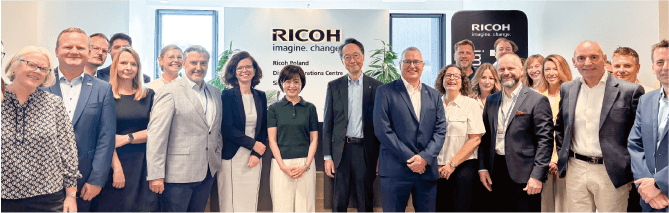
Interaction with employees at Ricoh Poland
The skills required by our strategy are also changing. We will strengthen our talent portfolio around digital, AI, and global capabilities, while recognizing that specific needs differ by region and business. Human capital investment must be linked to strategy. By allocating talent and development resources to the capabilities required for future growth, we can increase the value created by our people and improve the return on human capital investment.
Employee engagement has improved, but it is not yet at the level we seek. Employees need to understand how Ricoh’s strategy connects to the mission of their organization and to their own responsibilities. When expectations are clear, people can identify the skills they need, take on new challenges, and see how their contribution affects company performance. It is also important that achievement leads to recognition and further opportunities for growth. Creating this positive cycle will strengthen engagement and organizational performance globally.
An inclusive culture is indispensable to sustainable growth. The presence of diverse people alone is not enough; different perspectives must influence decisions and create new value. During my years working in Europe, I saw teams composed of people from many cultures and linguistic backgrounds debate issues thoroughly. The process could appear difficult, but over time the key options became clear, their advantages and disadvantages were evaluated, and the group reached a rational conclusion. Once the decision was made, everyone committed to it.
That experience reinforced my belief that innovation requires both the incorporation of varied viewpoints and an inclusive process. Homogeneous organizations can be vulnerable to conformity and may fail to challenge assumptions. In an era when continuous innovation is essential, we must create a culture in which people with different experiences can express their views, listen to one another, and influence decision making. This is central to how Ricoh will strengthen human capital.
Aligning ESG and Business Growth
Ricoh does not view ESG and business growth as separate agendas. We believe that helping to resolve social issues can strengthen competitiveness and create opportunities for growth.
The Ricoh Group aims to help realize a sustainable society guided by the three Ps—Prosperity, People, and Planet. Economic development and social progress can often reinforce one another, but economic growth and environmental sustainability are not always easy to reconcile. Innovation enables us to move beyond this perceived trade-off and create value across all three dimensions. Ricoh’s mission is to help people at work unleash their creativity. By providing environments in which people can work more intelligently, collaboratively, and creatively, we support customers’ innovation. That innovation can, in turn, resolve social issues. This connection—from the workplace, to creativity, to innovation, and ultimately to the resolution of social issues—is how Ricoh aligns ESG with business growth.
Environmentally conscious products demonstrate that this alignment can be practical. Reducing the use of new resources, increasing recycled content, and improving energy and resource efficiency contribute to environmental goals. If these improvements are achieved while maintaining quality, controlling costs, and meeting customer needs, they also strengthen competitiveness. Customers increasingly seek products and services that support their own ESG objectives, creating opportunities for Ricoh to generate both environmental and economic value.
The foundation of this approach is the Spirit of Three Loves: Love your neighbor, Love your country, Love your work. “Love your neighbor” means valuing all stakeholders involved in our business. Growth that depends on imposing an excessive burden on employees, customers, partners, communities, or other stakeholders cannot be sustained. “Love your country” means helping to resolve social issues and continuing to provide value as a member of society. “Love your work” reflects the importance of people, engagement, and an environment in which individuals can thrive and contribute.
This philosophy has guided Ricoh since its founding. Today, we express it through stakeholder-focused management and through specific targets for Prosperity, People, and Planet. By pursuing our three Ps targets toward 2030, we will work to create social and economic value simultaneously and translate that value into sustainable corporate growth.
Determination to Achieve Mid-Term Strategy ’26
The challenge is a race against time. There is a gap between the speed at which markets and investors expect results and the time required for initiatives to produce them. Our responsibility is to narrow that gap. This requires judgment. Measures that are rational and aligned with the overall strategy must be executed without hesitation. At the same time, decisions that have a significant effect on organizational unity or employee motivation require careful discussion and follow-up. Speed and discipline do not mean acting without consideration. They mean knowing where rapid action is essential and where thoughtful implementation will produce a stronger result.
In the end, shareholders, investors, and other stakeholders will evaluate us by our results. The external environment is undergoing rapid change, and management must respond with agility, leverage those changes as opportunities, and convert action into performance. Achieving ROE of 10% is an essential management objective. We will pursue it by transforming our earnings structure, reshaping the business portfolio, increasing recurring earnings, expanding asset-light businesses in the Workplace Services domain, strengthening the competitiveness of our printing businesses, and improving capital efficiency. We have also revised executive compensation so that it reflects the extent to which ROE exceeds the cost of equity, thereby strengthening management’s alignment with shareholder value.
Fiscal 2026 is particularly important because it is the first year in which we must demonstrate that the recurring earnings base is expanding as planned and that the measures established under Mid-Term Strategy ’26 are translating into performance. We will monitor the leading indicators closely, respond quickly when progress falls behind, and communicate clearly about both results and the actions being taken. We are now moving from building the foundation to delivering the results of transformation. Our immediate priority is to achieve the fiscal 2026 targets and place Ricoh firmly on the path to ROE of 10%.
We will show progress through performance, rebuild trust one result at a time, and continue enhancing corporate value over the medium to long term. Through this transformation, we are committed to building a stronger, more resilient Ricoh and creating lasting value for all stakeholders.
