
 Global
Structures and Systems
At Ricoh Group, we promote environmental management through a management system in which management and environmental decision-making are integrated.
In order to realize environmental management, it is important if business operations and environmental conservation proceed under the same decision-making process, rather than being pursued separately. The Ricoh Group promotes sustainable environmental management by incorporating the environmental management system (EMS) as an essential process of each business activity. Decisions on the promotion of environmental management and other various commitments based on the EMS concept are made by the ESG Committee, chaired by the CEO with oversight, supervision, and advice from the Board of Directors. Environmental targets and strategies developed by our top management are incorporated into the targets of each organization, and a system has been established to ensure that the results of activities are fed back to top management, and a PDCA (Plan-Do-Check-Act) cycle is implemented for the entire group and each organization to manage and monitor environmental risks and opportunities. In addition, we operate the Sustainable Environmental Management Information System, designed to identify and promote the progress of sustainable environmental management. Using this system, we monitor the environmental impact and environmental compliance of our entire business activities, utilizing the results for target setting and strategy formulation, making decision on environmental management, promoting environmentally-friendly design, improving activities by division, training for employees, internal audits, and information disclosure to stakeholders.


Enhancing and Raising the Level of Environmental Management System
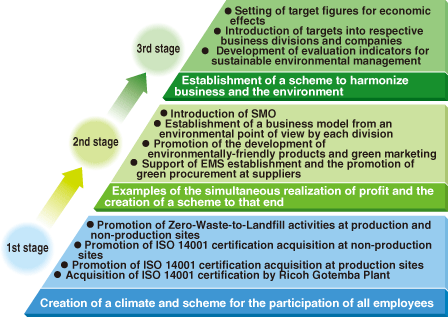
At the Ricoh Group, we have been working to develop and improve environmental management systems (EMS), initially on a business site basis, to accelerate our environmental conservation activities. Starting with the Ricoh Gotemba Plant, which received ISO/DIS 14001certification in 1995, all major Ricoh production sites worldwide were ISO 14001 certified by March 2000. Then in 2001, all the group sales subsidiaries in Japan as a whole received ISO 14001 certification. The overseas sales subsidiaries are also making every effort to acquire ISO 14001 certification. The Group has thus promoted the creation of a climate for sustainable environmental management by all employees through the acquisition of ISO 14001 certification. (Since February 2007, in an effort to fuse business and environment and pursue environmental management, our business site-based EMS worldwide were revised to become business division-based, placing business activities and environmental protection activities under a single decision-making process. In tandem with this initiative, Ricoh and its sales subsidiaries in Japan have acquired integrated ISO 14001 certification. Moreover, in December 2013 accreditation was completely integrated within Japan, governance was strengthened while at the same time a rationalization of accreditation business was conducted.) Since February 2007, we changed to an EMS that incorporates environmental risks and opportunities into the processes of each business activity to integrate business and environmental management, and to promote business and environmental conservation activities under the same decision-making process. In December 2013, we integrated all domestic certifications to strengthen governance and improve the efficiency of certification operations.
* For the status of the Ricoh Group’s ISO 14001 acquisition, please visit “Ricoh Group’s ISO 14001”
Participatory Approach by All Employees
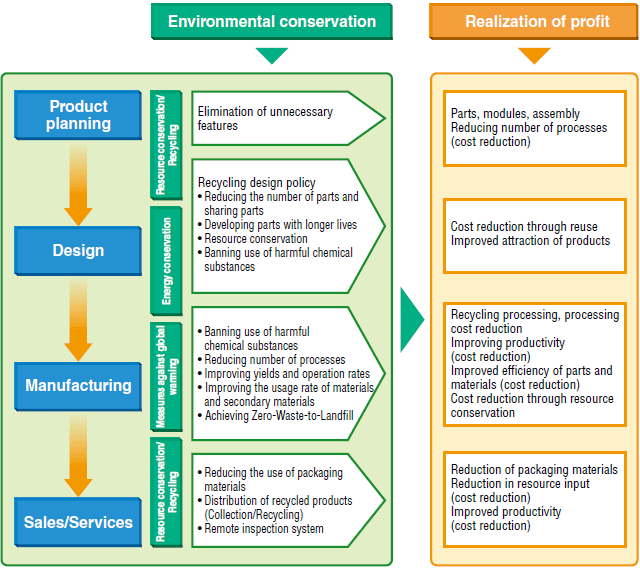
At Ricoh, we are making efforts to improve sustainable environmental management based on the “All Employee Participation Approach”. This “All Employee Participatory Approach” means that all employees in all divisions—such as R&D, product design, procurement, manufacturing, logistics, sales, maintenance/services and collection and recycling—participate in environmental activities through incorporating an environmental perspective.
These activities are regarded as just as important as “QCD activities,”* which involve pursuing profitability. To improve environmental activities, internal benchmarks and know-how are provided to all employees from time to time to make them more environmentally aware. For example, the rules that each and every employee must follow in all processes, including due diligence, compliance with environmental laws and regulations, and training plans, are incorporated into the Ricoh Group Standards (RGS), which are linked to our daily activities.
The Ricoh Group’s basic policy for environmental management is to simultaneously reduce environmental impact and generate profits. The foundation of the Ricoh Group’s environmental management is for each employee to be aware of how his or her activities affect the environment.
*QCD activities improve the management of Quality, Cost, and Delivery.
Environmental Education
To reduce environmental impact and contribute to environmental conservation, it is essential to instill environmental awareness among all employees. Based on this recognition, the Ricoh Group conducts various environmental education initiatives.
1.Ricoh Global SDGs Action Since 2006
Ricoh has been organizing the environmental event "Global Eco Action" every June since 2006 to encourage reflection and action on global environmental issues. In 2019, "Global Eco Action was renamed "Ricoh Global SDGs Action," focusing not only on eco-actions such as measures against global warming towards achieving a decarbonized society, but also on addressing a wide range of social issues collectively by group employees.
2.SDGs Online program
We have developed the SDGs online program focusing on themes deemed crucial in the fields of environment, society, governance, and social contribution. Environmental themes include achieving a decarbonized society and promoting a circular economy. These courses consist of approximately 10-minute lectures provided through video content, designed to be accessible during spare moments, with knowledge retention ensured through assessment tests. They are stored on an ESG education site accessible to all employees to ensure a correct understanding of ESG/SDGs.
3.Evaluation Activities and Environmental Education in Production Areas
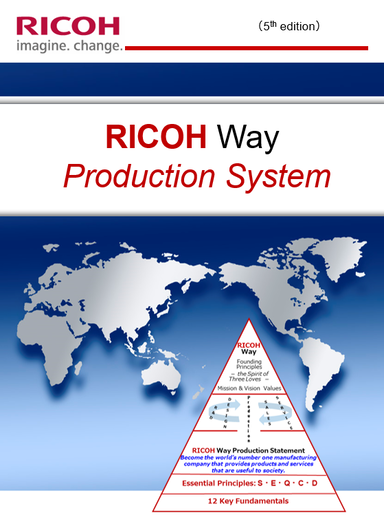
Ricoh Group promotes "Ricoh Way" practices specifically in production areas. As a foundation for manufacturing, it has established 12 fundamentals including environmentally friendly production activities, implemented in production facilities both domestically and internationally. One notable feature is the participation of all employees. Beyond global awareness, each production facility's adherence to these principles is evaluated, incorporating employee interviews based on specific criteria. Facilities with lower evaluations learn from those with higher evaluations, leading to overall improvement in implementation across all production sites. To enhance environmental practices, Ricoh Group has created booklets and practical manuals incorporating good practices in environmental management (such as energy consumption reduction), circular economy (resource efficiency, waste reduction), efficient water use (water conservation), pollution prevention policies, goals, and exemplary practices in production sites. These educational materials are provided to domestic and international production facilities, accompanied by comprehension tests for all employees at targeted production sites* (FY2023 implementation rate: 100%). With the evolution of Ricoh Group's environmental management, these booklets and manuals are periodically revised.
*Targeted production sites: 19 production sites for main products (MFPs, printers, scanners, commercial/industrial printings, digital cameras, embedded computers, etc.)
Risk management
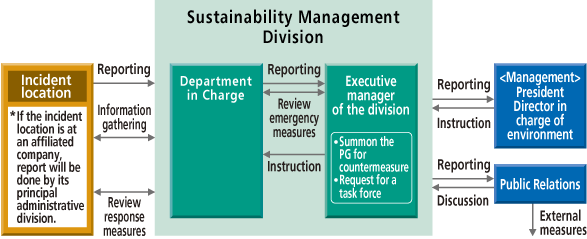
The Ricoh Group carries out risk management as an inner control function using the PDCA cycle based on the Ricoh Group’s Total Risk Management Basic Rules. For initial measures taken in case of crises*, the Rules clearly define the sections in charge and reporting levels according to the different crisis categories. In line with the Rules, pertinent incidents are reported to the president and relevant officers, then necessary measures are taken based on the president’s policies. When an environmental crisis or an incident that seemingly will lead to an environmental crisis occurs, initial actions, including reporting and reception of information, instruction, actions and discussion, will be carried out as indicated in the accompanying flow chart.
*Crisis: an incident with a risk that continues and/or increases in size to the level at which the corporate
| FY 2021 | FY 2022 | FY 2023 | FY 2024 | |
|---|---|---|---|---|
| No. of cases | 0 | 0 | 0 | 0 |
| Amount (US$) | 0 | 0 | 0 | 0 |
*Environmental laws and regulations, including wastewater regulations
Green purchasing
The Ricoh Group is promoting green purchasing, which promotes the active use of environmentally-friendly products, as a user of paper, stationery, office equipment, etc. In April 2002, the Ricoh Group formulated Green Purchasing Guidelines in Japan for eight categories: paper, stationery, office equipment, OA equipment, home appliances, work gloves, work uniforms, and lighting. Production and non-production sites outside of Japan are also promoting green purchasing by establishing their own standards.